1.3 Million Faces, 48 Arrests
Essex Police's facial recognition scans 1.3 million faces for 48 arrests, exposing bias and low efficacy. Government expansion ignores evidence of inefficiency and unfairness in policing tech.
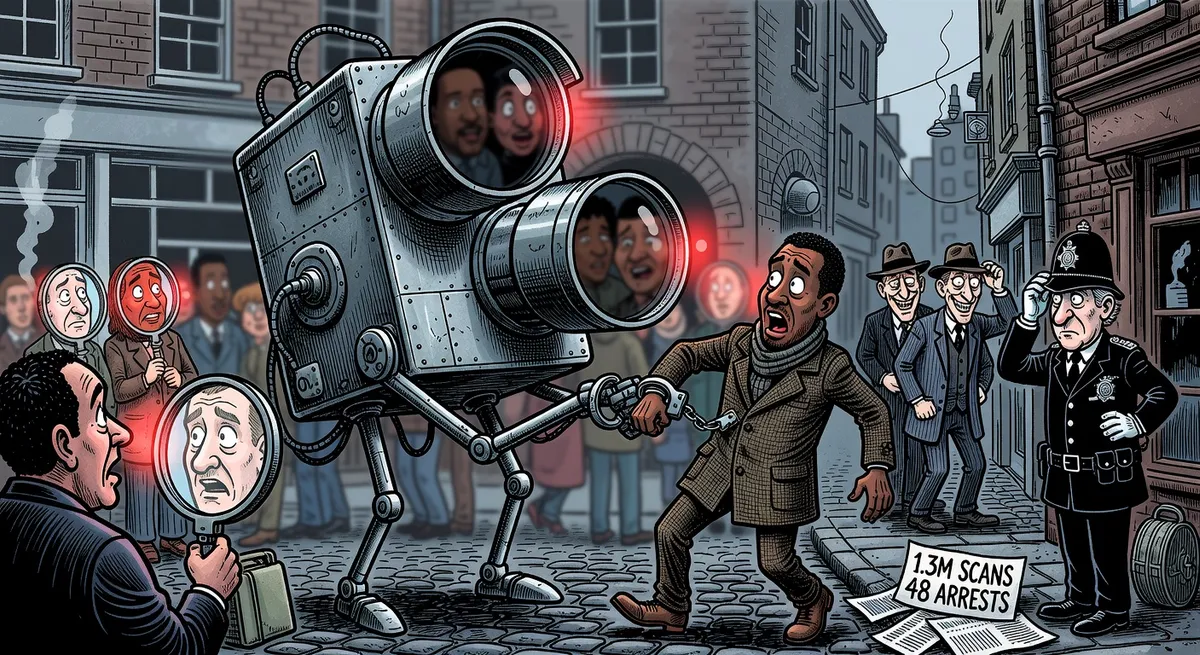
Essex Police LFR yields one arrest per 27,000 scans amid bias pause
Essex Police scanned 1.3 million faces from August 2024 to February 2025 using live facial recognition vans. Those scans produced 48 arrests and one mistaken intervention. The yield: one arrest per 27,000 people scanned.
A University of Cambridge study exposed bias in the system. Cameras correctly identified black people at statistically higher rates than other ethnic groups. Men faced higher detection than women.
Essex Police paused deployments after the first of two commissioned studies flagged this disparity. They updated the algorithm with the provider’s help. A second study cleared the system for resumed use.
The government plans expansion. Home Secretary Yvette Cooper announced in January an increase from 10 to 50 LFR vans nationwide. Thirteen forces already deploy the technology.
Performance data undercuts the rationale. Half of watchlist targets went undetected in tests. “Extremely rare” false positives mask the core inefficiency.
London offers a benchmark. Metropolitan Police LFR led to 1,300 arrests for serious crimes like rape and GBH from January 2024 to September 2025. Yet national rollout proceeds without uniform success metrics.
Privacy costs compound the flaws. Images delete automatically on non-matches, per Home Office claims. But 1.3 million scans in Essex alone fuel data retention concerns.
The Information Commissioner’s Office demands routine bias testing. It warns of unfairness from design, training data, or watchlists. Forces conduct assessments sporadically at best.
This mirrors public sector tech rollouts. Systems launch with fanfare, reveal flaws under scrutiny, then patch and persist. Cross-party governments repeat the cycle, from contact-tracing apps to border software.
Policing strains amplify the risks. Shop theft syndicates raid chocolate shelves unchecked. Meningitis clusters kill on campuses. Drug-drivers serve fractions of sentences.
LFR promises targeted enforcement. Reality delivers mass surveillance with marginal gains. Ordinary citizens bear the scrutiny; criminals evade nets stretched too wide.
Institutional trust erodes further. Minority communities face disproportionate flagging. White counterparts slip through gaps unremarked.
Governments tout AI for “dangerous individuals off the streets.” Essex results show technology chasing volume over precision. Expansion ignores the evidence.
UK policing declines through such mismatches. Resources pour into high-tech vans while frontline capacity shrinks. Arrests lag thefts, violence, and border breaches.
The pattern endures across administrations. Labour accelerates LFR amid 41,000-plus boat arrivals. Prior Tories piloted it without resolving biases.
This reveals core dysfunction: officials prioritize deployment optics over outcomes. Tech fixes symptoms; systemic failures in oversight and accountability persist. Britain’s law enforcement apparatus scans faces but misses justice.
Commentary based on Essex Police pauses use of live facial recognition cameras due to racial bias concerns at Sky News.
← Back to commentary