Aid Target Slips Below Even the Downgraded Floor
The UK will miss its 0.3 percent aid target by hundreds of millions due to inflation and unchanged allocations, extending a record of scaled-back promises unmet.
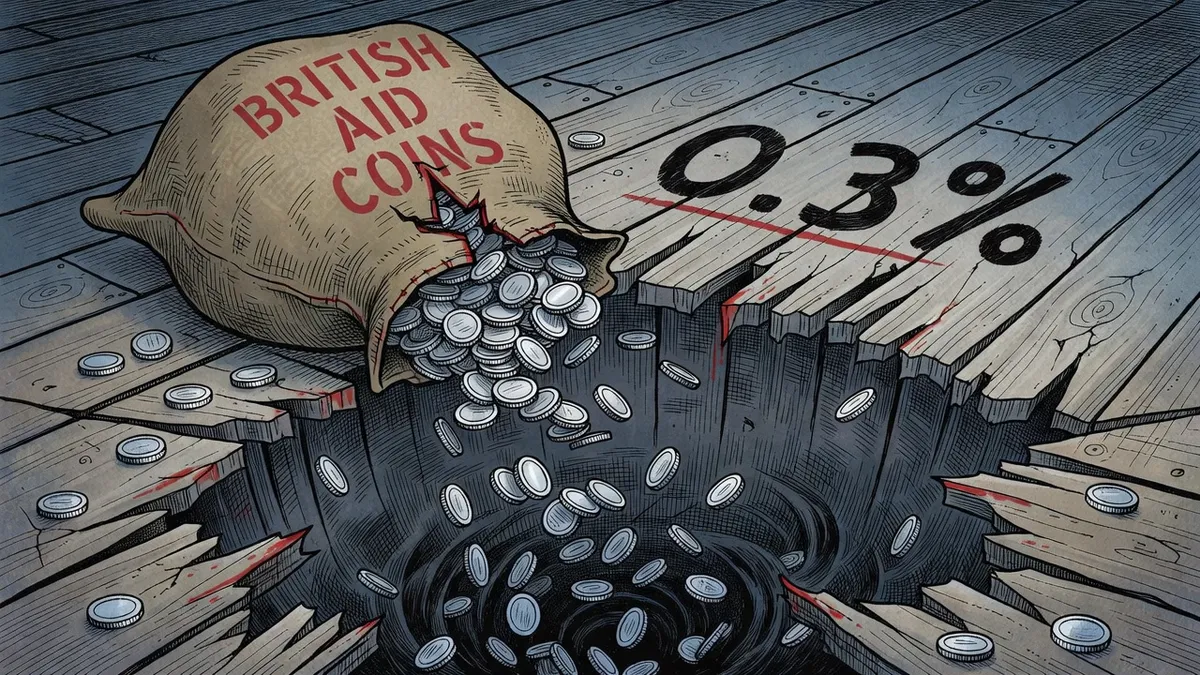
Higher national income and fixed budgets produce a £410m shortfall by 2027
Britain’s aid spending is tracking below even its sharply reduced target of 0.3 percent of national income. Calculations from the Center for Global Development project a central shortfall of £410 million by the end of 2027, with more pessimistic scenarios reaching £580 million.
The shortfall stems from higher-than-forecast inflation lifting gross national income while the Foreign, Commonwealth and Development Office budget remains fixed in nominal terms. This follows an earlier drop from 0.5 percent of GNI in 2024 to 0.44 percent in 2025, a reduction of £987 million.
Spending on the least-developed and low-income countries fell 6.7 percent, or £118 million, in the latest data. Multilateral channels such as the World Bank’s International Development Association absorbed a larger share, leaving bilateral programmes in Africa exposed.
The 0.3 percent figure itself replaced the 0.7 percent commitment contained in Labour’s 2024 manifesto. That pledge was scaled back to accommodate higher defence outlays, yet the revised target is still not being met.
Opposition parties have signalled further reductions, with some proposing cuts to roughly £1 billion annually. Such moves would eliminate contributions to core UN and World Bank programmes without altering the underlying delivery shortfalls.
The pattern shows successive governments announcing targets, adjusting them downward when fiscal pressure appears, and then missing the new benchmarks. Recipients in the poorest countries register the direct result in reduced programme funding.
Commentary based on UK poised to miss reduced aid spending target of 0.3% of national income by Rowena Mason on the Guardian.
← Back to commentary