Army Suspends Tank Training to Meet Budget Limits
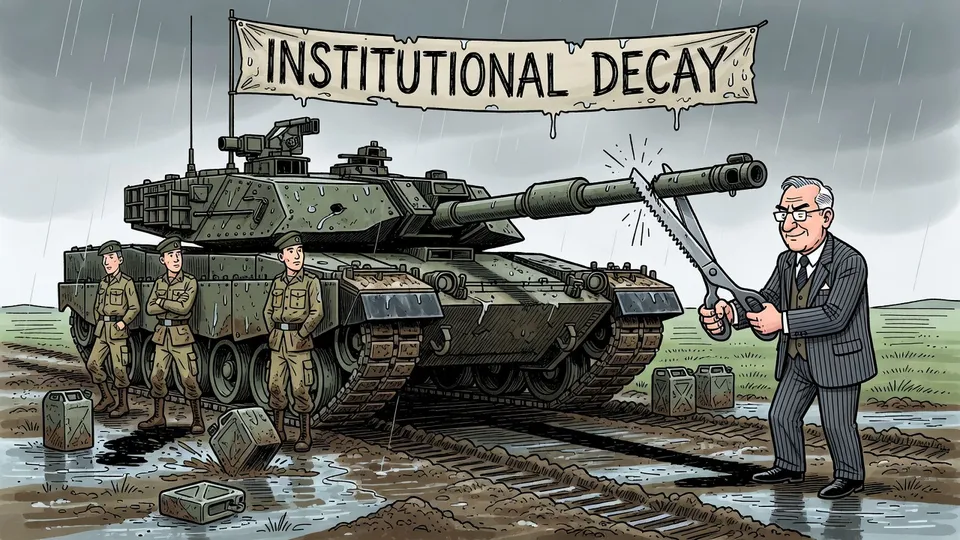
Collective exercises halted for most of the year while spending targets drift
UK forces cut non-essential drills amid unresolved shortfalls, even as ministers restate rising defence percentages without fixed funding.
Commentary Based On
the Guardian
British army told to halt non-essential training exercises to save money
The British army has suspended collective training for UK-based units for most of the year to reduce spending, with exercises involving tanks and Apache helicopters among those cancelled.
Only forces already preparing for deployment or on standby will continue normal training. The army stated it is prioritising activities tied to Ukraine lessons, including drone warfare, while claiming a £2 billion investment in training modernisation over 15 years.
Current plans target defence spending at 2.7 percent of GDP by 2027-28. No binding timetable exists for the 3 percent level by 2030 or the 3.5 percent target by 2035.
Budget Pressures and Readiness
The suspension directly limits large-scale unit coordination required for sustained operations. Tank and helicopter formations lose critical practice time, reducing the pool of fully proficient crews available for rapid response.
Ministers have yet to identify the additional £1.4 billion per year needed to meet even the 2.7 percent commitment. The Treasury defers detailed funding decisions until next year’s spending review.
Political Continuity
Labour MP Tan Singh Dhesi, chair of the defence select committee, pressed Prime Minister Andy Burnham for a firm path to 3 percent spending. Burnham’s chancellor, John Healey, previously resigned as defence secretary over inadequate funding before taking his current post.
The same gap between announced targets and actual resource allocation has appeared under multiple governments. Each administration issues higher percentage pledges while operational training contracts.
This approach leaves force elements less prepared for peer-level conflict despite repeated public statements on rising threats. Equipment remains in service, but the skills to employ it at scale erode through repeated short-term savings measures.
The armed forces absorb successive efficiency demands while political commitments expand without corresponding budget certainty. Ordinary service personnel face reduced opportunities to maintain core competencies, and the gap between stated strategic intent and daily reality widens.
Commentary based on British army told to halt non-essential training exercises to save money by Jamie Grierson on the Guardian.