Barracks Absorb 350 Asylum Seekers Amid Council Evasions
Home Office shifts asylum seekers to disused military sites without transparency, prompting council evasions and protests. This reveals cross-party border failures turning towns into dispersal zones amid unchecked inflows.
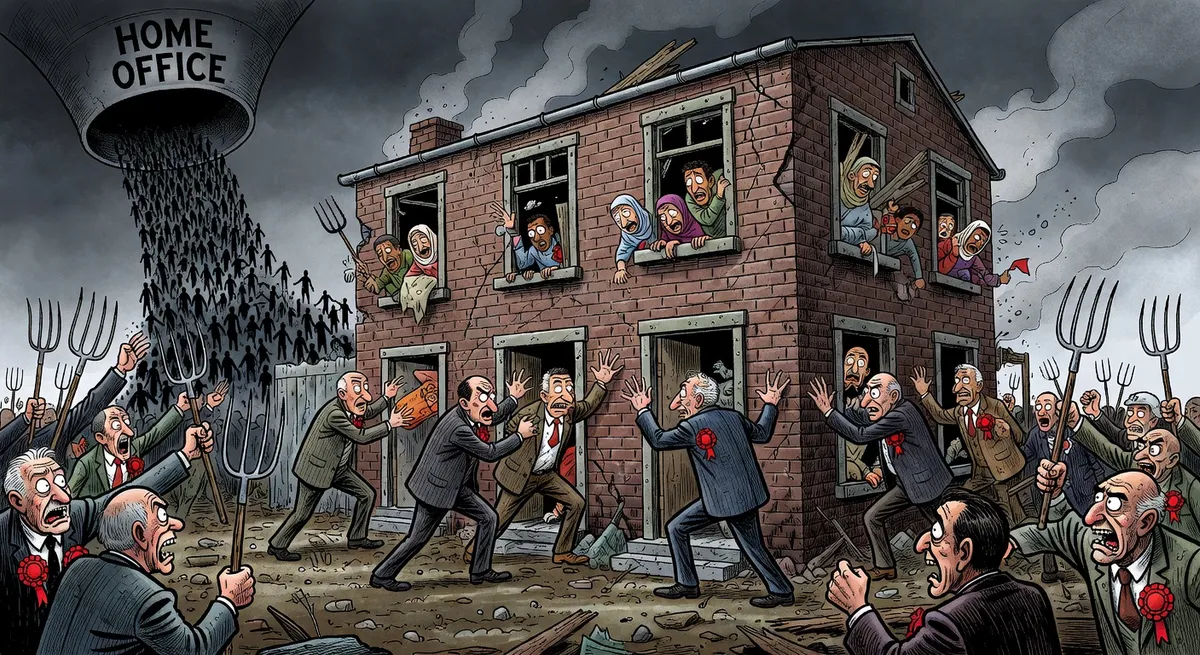
22,000 potential beds eyed as 6,000 arrivals overwhelm hotels
Home Secretary Shabana Mahmood announced the closure of 11 migrant hotels last week, claiming progress on a £7 million daily cost.
Reality differs. The Home Office shifted 350 single men to a disused camp in Crowborough, East Sussex, three months prior. Inverness barracks prepare for 300 more.
GB News queried 63 councils with barracks slated for disposal over 12 years. Responses reveal institutional deflection.
Twenty-five councils reported no plans for migrant housing.
Eight others denied Home Office contact but directed questions to Whitehall: Breckland, Central Bedfordshire, South Kesteven, Kirklees, Rushmoor, Shropshire, South Oxfordshire, Vale of White Horse, and Vale of Glamorgan.
Four refused answers outright: Aberdeen City, City of York, Pembrokeshire, and South Lanarkshire.
Site Capacities Scale to Small Cities
These sites hold potential for 22,000 asylum beds.
Prince William of Gloucester Barracks near Grantham could fit 3,000—equivalent to a market town’s expansion.
The Ministry of Defence delayed its 2020 sale plan by nearly a decade. South Kesteven Council claims no interest, unaware of third-party nominations.
Crowborough residents discovered the placement after arrival. Conservative MP Nusrat Ghani and local Tories learned via back channels; Wealden’s Green-Lib Dem coalition held unannounced talks.
Home Office policy skips operational commentary. It confirms scaling barracks use with councils.
Inflows Outpace Dispersals
Over 6,000 small boat arrivals hit UK shores this year—enough to refill Crowborough 17 times.
Migrants receive £50 weekly allowances, no curfews, and 20-minute walks to town centers.
Claims process asylum bids in up to three months at such sites, versus indefinite hotel stays.
Protests draw hundreds in Crowborough, with England flags, council tax boycotts, and women’s groups citing safeguards.
The Pink Ladies link placements to crimes like Rhiannon Whyte’s 2024 murder by small boat arrival Deng Majek, housed at a migrant hotel.
Cross-Party Border Inertia
Labour targets 30,000 hotel exits by 2029, inheriting a 100,000-plus backlog.
Conservatives under Sunak promised Rwanda flights but delivered none before defeat.
Both parties oversee unchecked Channel crossings: 45,000 in 2022, 29,000 in 2023, 6,000-plus in 2024.
Shadow Home Secretary Chris Philp demands site lists, warning of illegal work, crime, and vanishings in dispersal housing.
Accountability Dissolves
Councils pass responsibility upward. MPs protest post-facto. Whitehall withholds details.
This mirrors hotel-to-barracks shifts under prior governments, including army sites in 2023.
No minister or council leader faces electoral or professional penalty for secrecy.
Communities bear unvetted influxes: Crowborough’s “upside down” lives, Grantham’s potential 3,000.
Functional governance would publish sites, enforce returns, and cap arrivals.
Instead, deflection perpetuates overload.
Dispersal to barracks exposes border control’s collapse. Councils and Whitehall coordinate quietly while arrivals multiply. Britain’s towns become unwitting hosts in a policy of managed failure, eroding community trust without resolution.
Commentary based on Labour accused of audacious plot to create ‘migrant cities’ and flood towns with asylum seekers at GB News.
← Back to commentary