Cancer Treatment Shortfalls Hit 9,490 Patients
Official data shows widening gaps in timely cancer care driven by staffing shortages and capacity limits across England.
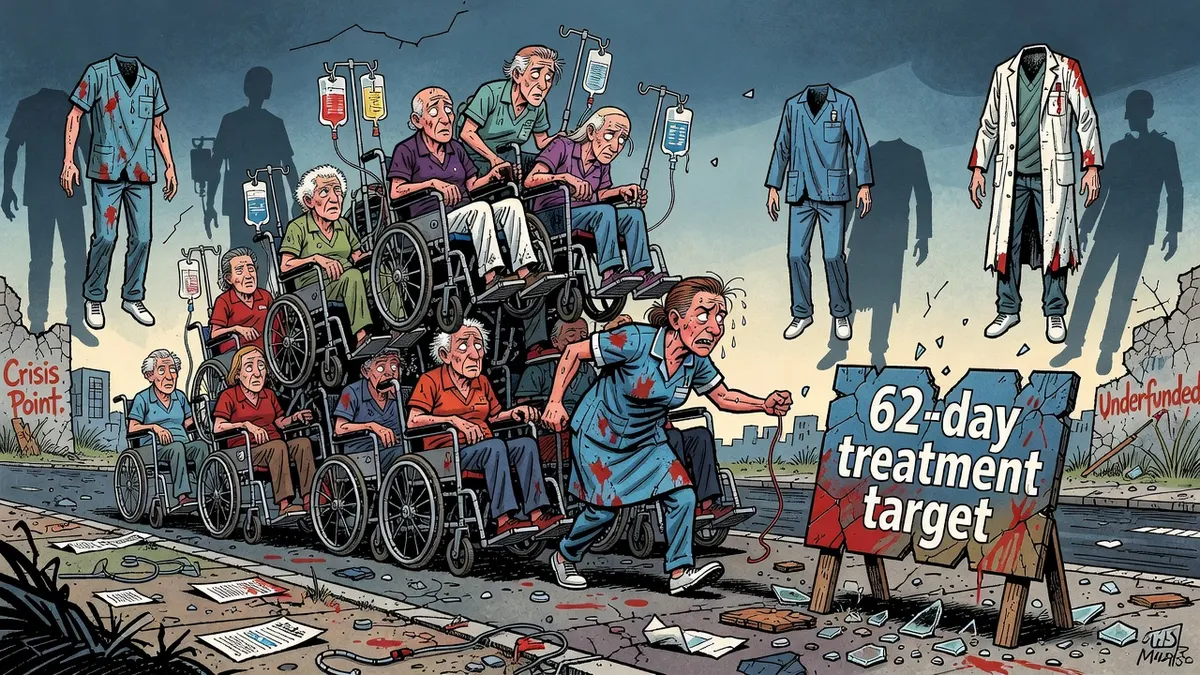
NHS England needs 2,850 extra cases treated monthly to meet the 80 percent target by March 2027
NHS England will fall short of its cancer treatment target by 9,490 patients. The service must treat 2,850 additional patients on time each month to reach the 80 percent goal set for March 2027. Current performance stands at 70.7 percent of cases started within 62 days.
The gap has widened in recent months. Performance fell from 71.9 percent in August to 70.7 percent in September. Official calculations show the NHS is treating only 21,500 patients within the target window against the 24,400 required monthly.
Treatment disparities by cancer type
Outcomes vary sharply by diagnosis. Prostate and breast cancer patients reach treatment within 62 days at rates of 70.1 percent and 68.8 percent. Lung cancer patients receive treatment on time in just 60.9 percent of cases. Gynaecological cancers sit at 60 percent and head and neck cancers at 56.5 percent.
Regional differences compound the problem. The Midlands records the lowest rate at 66.6 percent. London reaches 77.3 percent. These figures come from the same national system operating under identical funding rules.
Workforce and capacity constraints
Experts identify chronic staffing shortages as the primary barrier. Clinical radiologists and oncologists remain in short supply. NHS hiring freezes for these roles have doubled in the past year. Diagnostic and treatment capacity has not expanded in line with a 20 percent rise in urgent referrals over four years.
Diagnosis targets also lag. Only 55.4 percent of patients receive confirmation or clearance within 28 days against an 80 percent standard. Faster diagnosis yields no benefit when treatment pathways remain blocked further downstream.
Government position and structural patterns
The Department of Health states that all three cancer standards have improved from a year earlier. It points to a forthcoming national cancer plan as the mechanism for further progress. Past targets have slipped under multiple administrations without measurable correction to underlying capacity.
The pattern shows repeated commitments followed by persistent shortfalls. Accountability mechanisms have produced no visible change in staffing levels or equipment deployment. Regional and cancer-type variations remain unaddressed by central planning.
These shortfalls translate directly into delayed intervention for thousands of patients each year. The gap between stated targets and delivered care continues to widen under current resource constraints.
Commentary based on NHS England on track to miss key cancer treatment target by 10,000 patients by Anna Bawden on the Guardian.
← Back to commentary