Cash Shortfalls Push Universities Toward Chinese Intelligence Risks
UK universities maintain deep financial ties to China while MI5 documents espionage through academic channels, revealing unresolved policy contradictions.
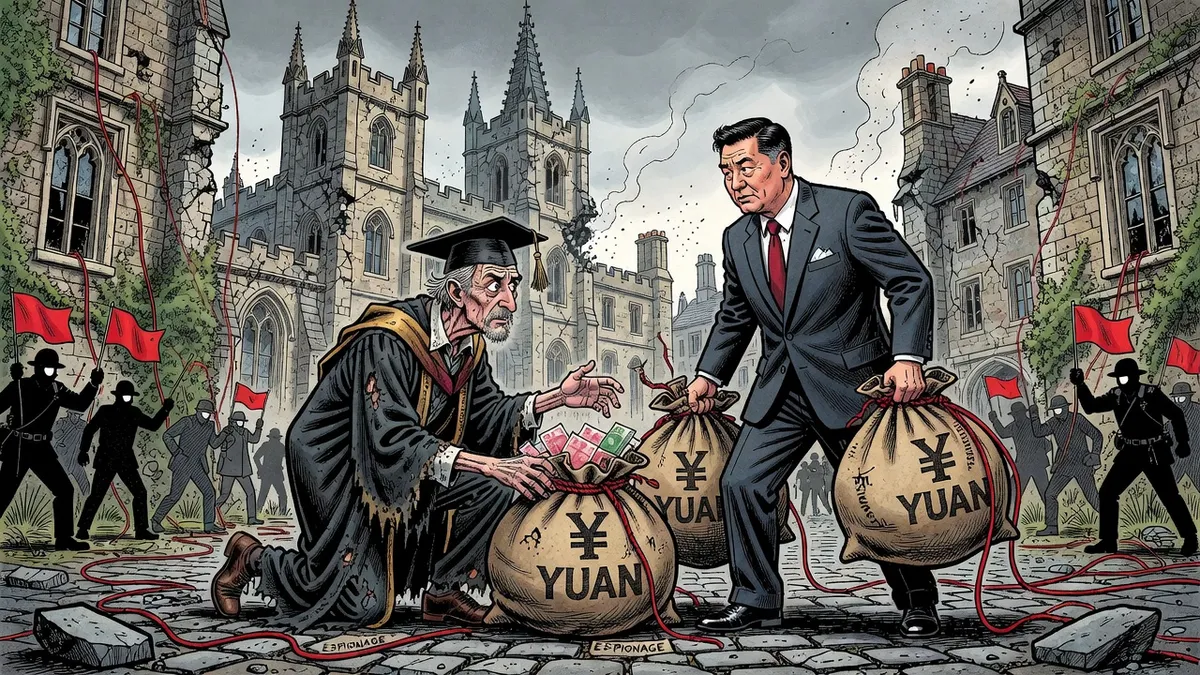
MI5 warnings collide with £600m annual revenue from Chinese students and partnerships
MI5 has identified the China Academy of General Technology as a front for the Ministry of State Security, directing payments to over 100 UK academics in artificial intelligence, cybersecurity and steganography. The agency issued a direct warning under the 2023 National Security Act to halt such work. Universities continue to accept funding and students from the same source.
Chinese students generate roughly £600 million per year for British higher education. China also accounts for more than a fifth of new transnational education partnerships approved in May. These figures place the UK ahead of Russia, France and Italy in volume of links with Chinese institutions.
The 2023 Intelligence and Security Committee report stated that UK universities provide a rich feeding ground for Chinese political influence and economic advantage. It warned of risks that China would direct or steal academic research. The current alert shows those concerns have not altered funding patterns.
Policy Vacuum
Experts note the absence of clear government rules on dual-use technologies. Charles Parton of RUSI observed that naming specific companies offers little practical help because Chinese entities routinely obscure origins. Meia Nouwens of IISS added that researchers lack defined limits on what constitutes a national security risk.
Without such boundaries, institutions must decide case by case whether collaboration crosses into prohibited assistance to a foreign intelligence service. The result is predictable: continued engagement until an alert arrives, followed by individual researchers absorbing the compliance burden.
Institutional Weakness
Higher education has operated under sustained financial pressure. Domestic research budgets and student fees have not kept pace with costs, leaving overseas revenue streams as structural necessities rather than optional partnerships. Successive governments have treated this dependence as an economic benefit rather than a strategic exposure.
The pattern matches broader UK practice: sectors facing domestic shortfalls turn to external actors for immediate cash while security services later document the downstream costs. No mechanism exists to reconcile the two priorities at scale.
This arrangement leaves individual academics and departments to manage risks that originate in national policy choices. The alerts will continue, the funding will remain attractive, and the underlying mismatch will persist.
Commentary based on MI5 China alert will send chill through UK’s cash-strapped universities by Amy Hawkins on the Guardian.
← Back to commentary