CCTV Cleared Him, Dorset Convicted Anyway
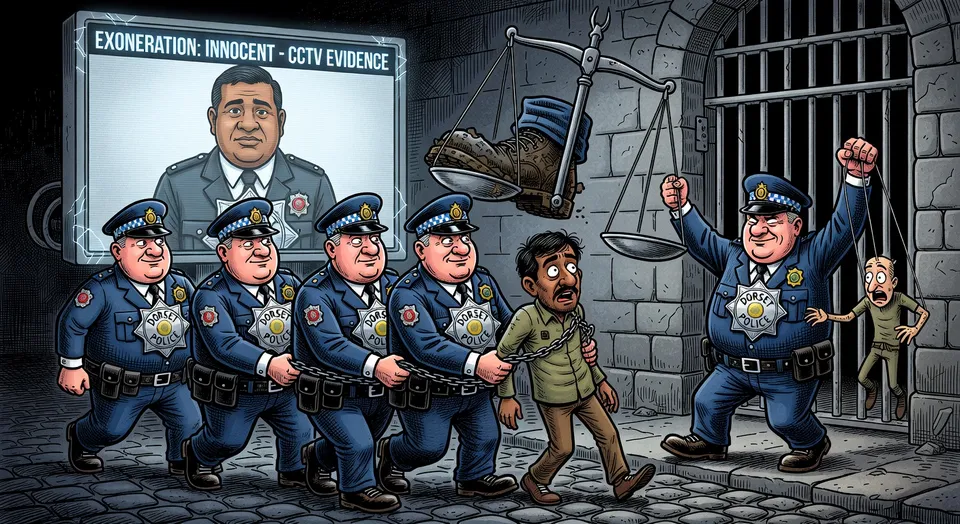
23 years served on coerced addict testimony
Dorset Police ignored their own CCTV disproving key witness, coerced 13 others to lie, and buried an alibi in a 2002 murder case. Benguit's 23-year imprisonment exposes unaccountable conviction engineering.
Dorset Police pursued conviction despite CCTV disproving their star witness.
Omar Benguit has served 23 years in prison for the 2002 stabbing of South Korean student Jong-Ok Shin. No forensic evidence or CCTV footage linked him to the crime scene. Prosecutors relied entirely on witness testimony that officers knew contradicted their own investigation findings.
The core evidence came from a witness called BB, a drug addict with a record of false allegations. She claimed she drove Benguit and two others past Shin, stopped the car, and watched Benguit stab the student after Shin refused a party invitation. This matched neither Shin’s dying account of a single masked attacker nor police-verified CCTV.
Officers reviewed CCTV from a BP garage BB said she visited before picking up Benguit. No footage showed her car or the men. Post-murder, BB described driving them to a crack house; CCTV across the street captured addicts entering but omitted BB’s group entirely.
Police buried phone records supporting Benguit’s alibi. These placed him using a phone box 25 minutes after the murder, contradicting BB’s timeline. Grainy CCTV from that box resembles Benguit, confirmed by earlier images that night.
Witness Coercion Multiplies
Thirteen prosecution witnesses told BBC Panorama police pressured them to embellish statements or lie outright. Four more refused such demands. Combined with prior admissions, all 15 key witnesses now stand discredited.
Leanne, aged 17 at the time, signed a pre-written false statement in a police car. Officers edited it on the spot, she said. Five crack house witnesses initially denied seeing Benguit, then uniformly claimed he arrived blood-soaked after police re-interviews.
Andi Miller admitted police leveraged his uncharged thefts to extract lies. He saw no bloodied Benguit but testified otherwise. Family of two others confirmed their admissions of perjury.
Intense public pressure drove the case. Bournemouth’s economy depended on international students; South Korea demanded swift justice. Dorset Police faced scrutiny after two mistrials, building around BB despite her shifting stories accusing three different men initially.
Alibi and Missing Tapes
Panorama uncovered documents showing Benguit’s circle used that Charminster Road phone box for drug deals. This bolsters the footage as his alibi. Yet 135 original investigation CCTV tapes vanished, per the Criminal Cases Review Commission.
The CCRC now reviews Benguit’s case. Retired detective Brian Murphy, with 200 murder probes under his belt, deems the conviction unsafe. He demands an Independent Office for Police Conduct investigation.
Dorset Police called their work “thorough, detailed and very complex” but dodged framing allegations. Benguit’s barrister Des Jenson labeled it manufactured evidence and justice perverted.
This episode exposes police as conviction factories, not truth seekers. Officers overlooked contradictions, coerced vulnerables—addicts, teens—and discarded exculpatory data. No firings, no charges followed; the force persists unchanged.
Patterns recur in UK policing. Recent busts of gun rings and migrant crime yield repeat offenders via lax courts, yet internal fabrication draws no reckoning. Dorset joins a list where public outrage prompts corners cut, innocents pay.
Institutional safeguards failed at every step. Prosecutors advanced discredited testimony. Courts convicted on it thrice. Oversight bodies like the IOPC activate only post-exposure, after decades served.
Citizens face the cost. A murderer roamed free while Benguit decayed in cells. Trust in police, already eroded by phone theft bailouts and border vetting holes, hits new lows. Bournemouth’s students gained no security from this theatre.
UK justice now manufactures certainty from lies. Police frame to close cases, politicians applaud results, and accountability evaporates. Twenty-three years stolen reveals the system’s true priority: protecting institutions over innocents.
Commentary based on Police framed man for murder, new evidence suggests at BBC News.