Council Blades Shred 30,000 Volunteer Hours
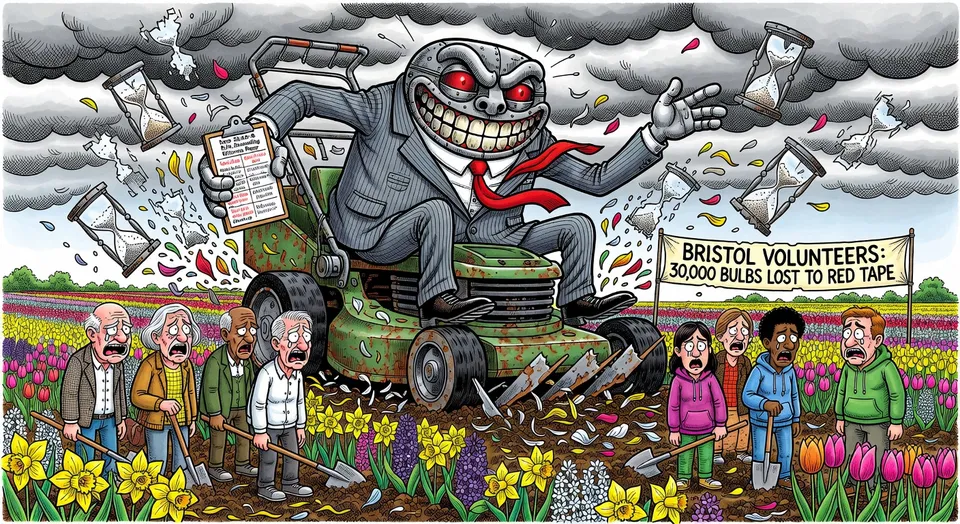
Bristol park planting, approved by conservation teams, flattened by operations staff
Bristol City Council mowed down 30,000 bulbs planted by volunteers days after coordination with its own teams, exposing departmental silos and eroding civic trust amid budget-driven reliance on unpaid labour.
Council mowers flattened 30,000 daffodil bulbs in Bristol’s St George Park, days after 70 volunteers planted them.
The Friends of St George Park group spent months planning the event. They coordinated with the council’s conservation and parks teams. Volunteers raised funds by selling 12,000 bags of duck food to cover costs.
Council operations staff then mowed the area flat. Volunteers reported prior notification to those teams. The bulbs, meant to boost park wildlife, now lie severed at ground level.
Ailie Tam, a group organiser, described the destruction as “demoralising.” Her children, who helped plant, returned to find their patches ruined. Victoria Bromley called it an “own goal,” with her four-year-old’s efforts erased.
Bristol City Council acknowledged the “upset and concern.” Officers now investigate the incident. They promise to liaise with ward councillors and volunteers.
Siloed Departments, Shared Failure
Conservation teams approved the planting. Operations teams handled mowing schedules. No records show communication bridged the gap.
This mirrors routine local government breakdowns. Departments operate in isolation, each disclaiming responsibility. Volunteers bear the cost of internal disconnects.
Budget cuts exacerbate reliance on such groups. Bristol Council slashed parks spending by 20% since 2010. Yet civic efforts face routine sabotage.
Patterns in Civic Erosion
Similar incidents recur nationwide. In 2023, Manchester volunteers replanted a community garden, only for council contractors to bulldoze it. Leeds saw wildflower meadows strimmed weeks after seeding.
Councils trumpet volunteer partnerships in annual reports. Actual delivery exposes coordination voids. Community groups fill gaps, then watch efforts nullified.
Trust in local authorities hits record lows. A 2024 Local Government Association poll found 62% of residents view councils as inefficient. Events like this accelerate the slide.
Volunteers invest time equivalent to 500 person-hours here. Funds raised could have sustained the project for years. Destruction wastes both, without reimbursement.
No staff face discipline yet. Investigations often conclude with vague apologies. The pattern shields operations teams from accountability.
Incentives Misaligned
Councils face pressure to maintain mowing quotas for grass verges. Operations prioritise schedules over ad-hoc plantings. Conservation input rarely overrides.
This reveals institutional priorities. Uniform upkeep trumps biodiversity goals. Volunteers serve as free labour, not partners.
National policy funnels £2.5 billion annually to local parks via grants. Much dissipates in mismanagement. Bristol’s episode underscores why.
Functional governance would log plantings in shared systems. Staff check digital calendars before blades engage. Bristol lacks such basics after decades of underinvestment.
Ordinary Bristolians lose twice. Parks degrade without volunteer boosts. Demoralised groups withdraw, ceding green spaces to neglect.
Cross-party councils repeat the errors. Labour-led Bristol mirrors Tory precedents elsewhere. Turnover in leadership changes nothing.
This incident lays bare local government’s core pathology. Institutions depend on citizen initiative to mask their decay, then mechanically destroy it. Britain’s civic fabric unravels one mown bulb at a time.
Commentary based on St George volunteers demoralised as council mows down 30k bulbs at BBC News.