DNA overrides Beachy Head plaque
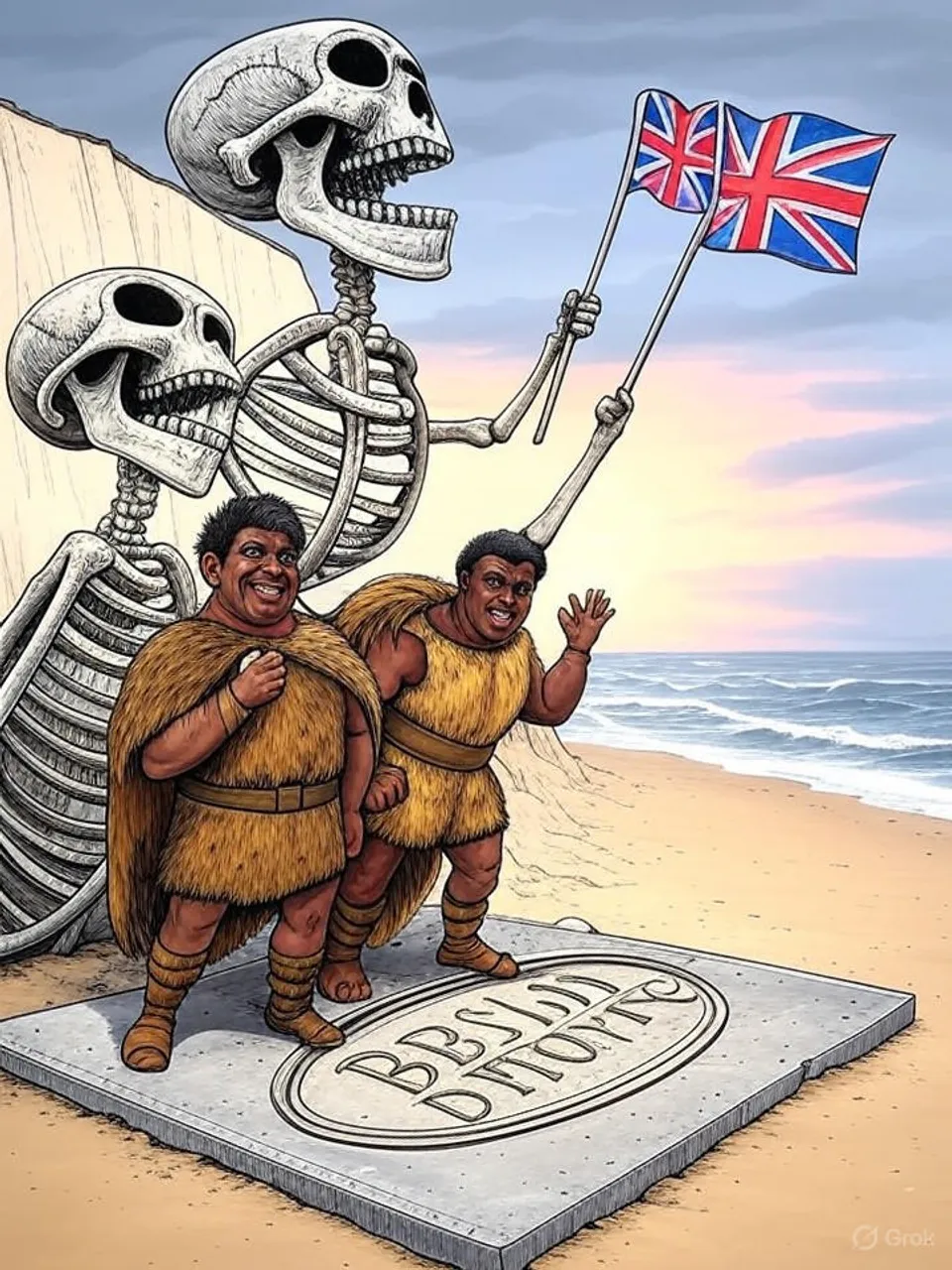
Roman-era African claim collapses under 17th-century white European evidence
Advanced DNA debunks Beachy Head Woman's Sub-Saharan origins, promoted by BBC and local authorities. Reveals pattern of taxpayer-funded historical revisionism eroding national heritage across institutions.
Commentary Based On
GB News
The idea that black Britons have been here from the beginning is bogus history - Colin Brazier
In 2012, Eastbourne Town Hall uncovered a female skeleton from Beachy Head, dated initially to the Roman era.
Scientists claimed Sub-Saharan African DNA, prompting a local plaque declaring her “of African origin” in 2nd-3rd century AD.
The BBC amplified this in “Black and British: A Forgotten History,” portraying her as the earliest black Briton with a dark-skinned facial reconstruction.
New radiocarbon dating and DNA sampling this week confirm she lived in the 17th century and had white European ancestry.
Local authorities now plan to revise the plaque.
This reversal exposes reliance on flawed early analysis.
Initial tests mistook trace DNA markers for definitive Sub-Saharan origin.
Wishful interpretation filled evidentiary gaps.
Institutions rushed to narrative fit.
Pattern of Overreach
Cheddar Man followed suit.
Announced in 2018 with black skin claims, his pigmentation evidence proved equivocal upon scrutiny.
Yet exhibitions persist, taxpayer-funded, asserting “Britain was black for 7,000 years.”
Stonehenge builders get recast as non-white natives.
Horrible Histories songs embed the myth for children.
Institutional Drivers
Media, universities, and lobby groups converge on this revisionism.
Septimius Severus, Libyan-born Roman emperor, morphs into “black Roman.”
Cleopatra and Hadrian’s Wall defenders receive similar treatment.
North African distinctions blur into Sub-Saharan categories.
Such claims ignore regional realities observed today.
Post-1997 Context
Brazier notes unprecedented immigration scale since 1997.
Prior waves—Huguenots, Jews, Irish—remained modest.
Enslaved domestics existed in small numbers.
Paintings and photos depict overwhelmingly white populations.
Revisionism challenges this visual record.
Political Echoes
Keir Starmer lauds Windrush arrivals as laying “foundations of modern Britain.”
In a 50-million population, thousands of post-war West Indians filled labor gaps.
Overstatement parallels historical inflation.
Sadiq Khan names an Overground line for Windrush, omitting Irish navvies’ infrastructure toil.
Selective memory elevates one group, sidelines others.
Cultural Cost
This erodes pride in verifiable heritage.
White Britons face denied continuity, unlike other ethnicities.
Black Britons receive fabricated belonging at truth’s expense.
Race-focused narratives allege centuries-long airbrushing.
Evidence for systemic erasure remains negligible.
Broader Decline
UK cultural institutions prioritize ideological conformity over empirical rigor.
BBC series, public plaques, and grants enforce migrant-island orthodoxy.
Cross-government funding sustains it—Labour exhibitions, Tory silences.
Truth bends to social engineering.
National cohesion fractures when shared history dissolves into competing fictions.
Ordinary citizens inherit distorted self-understanding.
Institutions that once preserved evidence now fabricate it.
The pattern spans decades, parties irrelevant.
Britain’s cultural apparatus documents its own unreliability.
Commentary based on The idea that black Britons have been here from the beginning is bogus history - Colin Brazier at GB News.