England Keeps Its Rivers Private
Official pledges for new river walks have delivered no measurable increase in public access while three-quarters of English riverbanks stay off-limits.
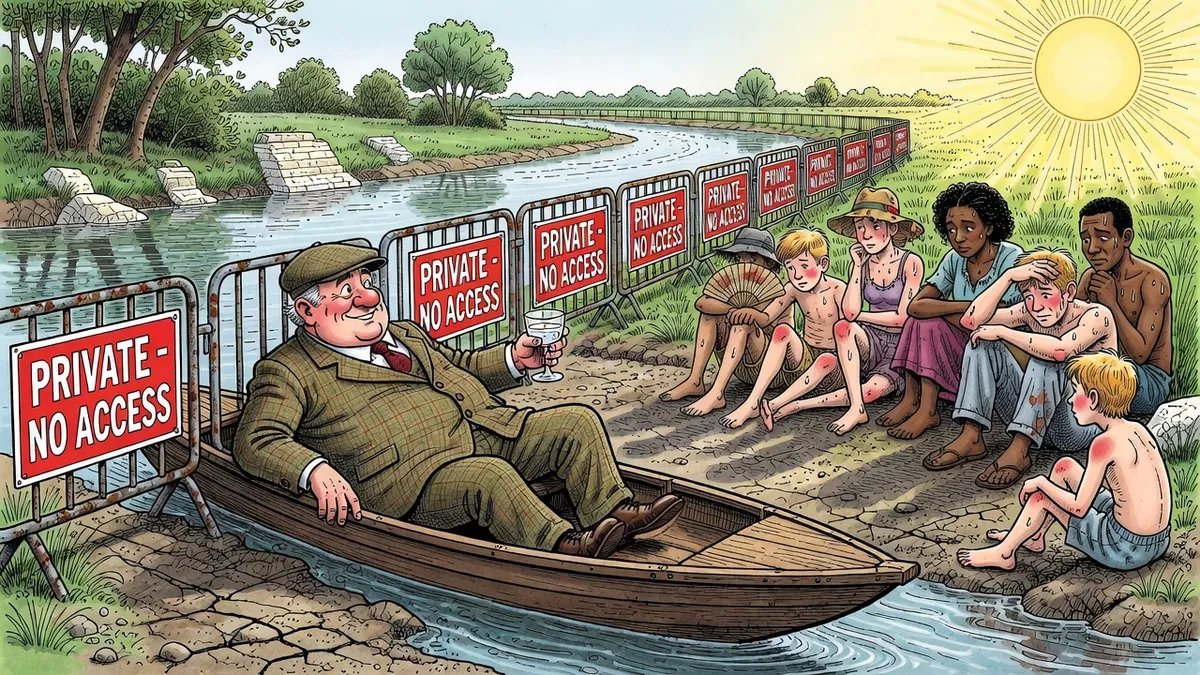
71 percent of riverbanks and 96 percent of water itself remain closed under existing law
England’s riverbanks stay closed to the public on 71 percent of main rivers and tributaries. Data from 89 catchments shows the figure holds whether urban zones are counted or not. Statutory rights to enter the water itself exist on just 4 percent of rivers in England and Wales.
The government response lists nine new national river walks as evidence of progress. The first, along the Mersey, produced no additional access points. Earlier commitments to consult on broader rights of responsible access remain unfulfilled.
Land Ownership Patterns
Private control of river edges dates back centuries and survives largely intact. Walkers on named trails such as the Severn Way or Test Way frequently find themselves diverted hundreds of metres from the water. Regional variation exists, yet even the best-performing catchment, the New Forest, still blocks access on 49 percent of its banks.
Heatwaves increase demand for free public cooling spots. Rescue services record repeated incidents where people enter water without legal entry points or safety infrastructure. The mismatch between seasonal need and fixed legal restrictions grows each year.
Policy Delivery Record
Ministers state they are restoring nature and expanding green space access. The same statements have accompanied successive access-to-nature papers without statutory change. No mechanism currently converts the announced walks into enforceable public rights.
The absence of rights produces predictable results. Landowners contest swimming and paddling on most inland waters. Reservoirs and lakes follow the same exclusion. Campaign data shows the pattern is structural rather than local.
Systemic Effects
Public exclusion from waterways reduces pressure for their upkeep. People defend places they can reach; places they cannot reach stay degraded. The same logic applies to other shared resources where legal access has narrowed over decades.
Current rules treat riverbanks as extensions of private holdings rather than corridors for public use. This arrangement persists across multiple governments and multiple heat episodes. The outcome is measurable: three-quarters of river frontage remains off-limits while official rhetoric emphasises reconnection with nature.
Commentary based on Almost 75% of England’s riverbanks ‘off limits’ to public, figures show at the Guardian.
← Back to commentary