Every English Water Body Registers Chemical Failure
All rivers, lakes and estuaries in England exceed limits for persistent toxins, with official targets missed by decades.
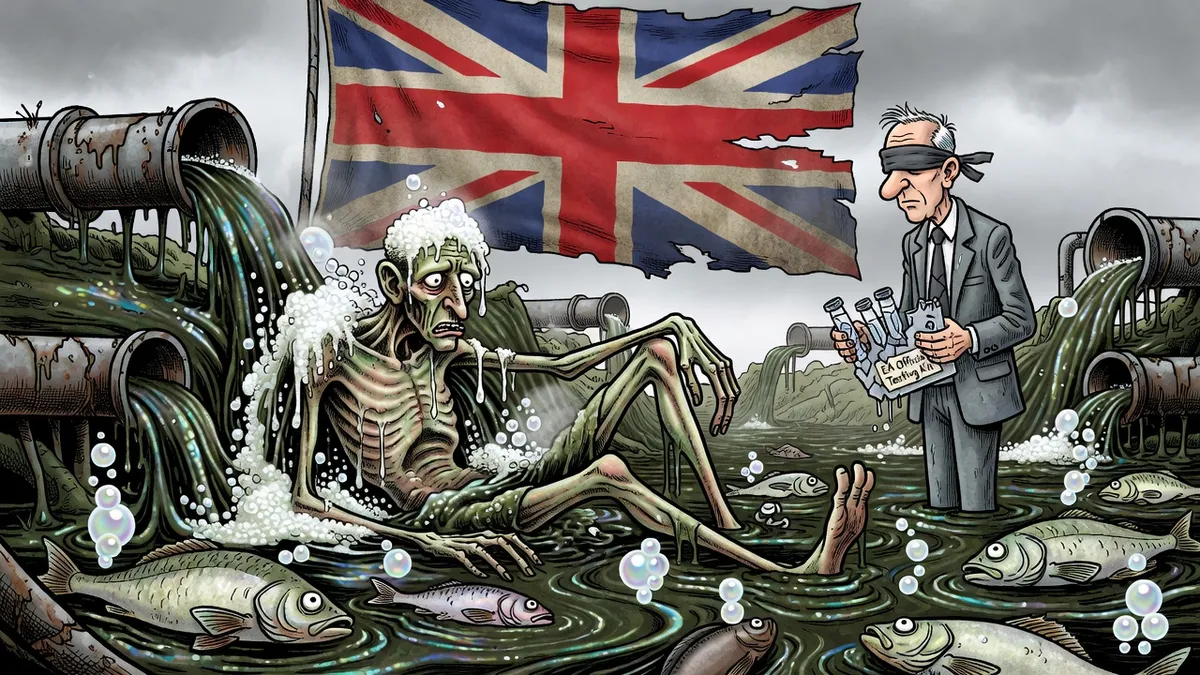
Environment Agency data shows zero compliance with chemical standards and recovery delayed until 2063
Every surface water body in England has failed chemical status assessments conducted by the Environment Agency. The latest six-yearly review found mercury, PFOS and PBDEs present above regulatory thresholds in every river, lake and estuary. No water body met the standard for good chemical status.
The official target required all waters to reach good chemical and ecological status by December 2027. Current projections now place chemical recovery no earlier than 2063. Ecological status has also deteriorated, with just 14.3 percent of surface waters rated good, down from 16.3 percent in 2019.
These chemicals do not degrade under normal environmental conditions. They accumulate in sediments and biota, entering food chains that reach human populations. The Environment Agency attributes the universal failure primarily to these three persistent substances, two of which remain in circulation through legacy products and ongoing releases.
Regulatory Record
The Environment Agency has recorded the data and issued the assessments. It has not prevented the contamination or enforced removal at source. Successive governments have left the agency without adequate powers or resources to address diffuse agricultural runoff and water company discharges at the required scale.
The UK has not matched European restrictions on PFAS chemicals. It remains one of the few countries that still permits mercury in dental fillings. Both decisions extend the period during which new inputs reach rivers and groundwater.
Sources of Continued Input
Water companies continue to release treated and untreated effluent containing chemical residues. Intensive agriculture applies fertilisers and pesticides at volumes that exceed the capacity of current catchment management. Neither sector faces financial penalties calibrated to the scale of the resulting environmental load.
The gap between legal standards and operational practice has widened. Enforcement actions remain infrequent relative to the number of non-compliant sites. Monitoring data now shows the cumulative result: zero water bodies passing the chemical test.
Institutional Continuity
The same pattern of missed targets and deferred action has persisted across multiple administrations. Each has restated commitments to water quality while leaving the underlying sources of contamination unaddressed. The 2063 projection indicates that current policy settings will not reverse the contamination within the working lifetimes of most citizens.
England’s water bodies now function as long-term storage for industrial and consumer chemicals introduced decades earlier. Recovery depends on natural degradation rates rather than active remediation. This outcome follows directly from the absence of sustained source control and enforcement.
Commentary based on All bodies of water in England polluted with toxic chemicals, official data shows by Pippa Neill on the Guardian.
← Back to commentary