Five Years Imprisoned, £500,000 Spent, No Redress
Brian Buckle cleared his name after wrongful imprisonment yet remains ineligible for any payout under rules designed to limit state liability.
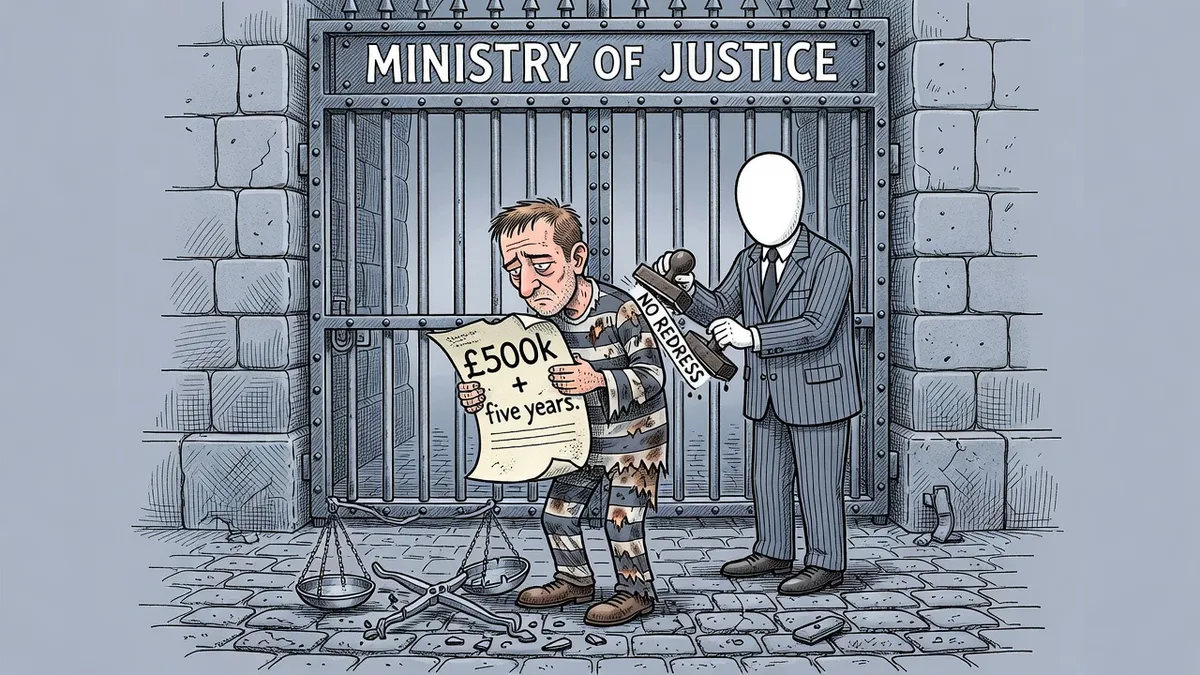
2014 statutory test blocks compensation after acquittal
Brian Buckle spent five years in prison after a 2017 conviction for historical child sex abuse. A retrial in 2023 produced new forensic evidence and witnesses that led to his unanimous acquittal. He spent £500,000 clearing his name and now faces rejection of his compensation claim for a second time.
The Ministry of Justice applied the statutory test introduced in 2014. That change requires applicants to prove their innocence beyond reasonable doubt rather than show that no reasonable jury could have convicted on the original evidence. Buckle’s legal team states that conclusive DNA or CCTV proof does not exist in this case, making the higher threshold impossible to meet.
The same rule produced the initial refusal in 2024. A further review ordered after parliamentary pressure reached the same outcome in April. Officials noted that quashing the conviction does not itself trigger compensation.
Statutory barriers
The 2014 amendment was explicitly designed to reduce payments from public funds. Ministry assessments at the time recorded the intended effect as lowering the burden on taxpayers. Barrister Stephen Vullo KC described the drafting as one that would ensure almost every claim fails.
This standard differs from the schemes created for the Post Office Horizon cases and from the interim payment eventually made to Andrew Malkinson after 17 years of wrongful imprisonment. Those arrangements bypassed the general test because the applicants would not have qualified under it.
Repeated outcomes
Buckle’s MP Ben Lake secured a Westminster debate and secured a ministerial review. Former justice minister Alex Davies-Jones publicly stated an intention to restore confidence in the system. Both interventions produced letters restating the original refusal without altering the criteria.
The Law Commission has now deferred its report on compensation until the end of 2026 because of public interest. Provisional proposals published in February 2025 recommended returning to the pre-2014 balance-of-probabilities test, but no legislative change has followed.
Scotland and Northern Ireland operate separate schemes. England and Wales retain the stricter test that leaves successful appellants without financial redress even after years of imprisonment and substantial legal costs.
The pattern shows a system that records miscarriages of justice as resolved once convictions are quashed while shifting the financial and health consequences onto the individuals affected. Buckle reports ongoing PTSD and medication use. Similar outcomes have followed other documented wrongful convictions where the 2014 test applies.
Commentary based on Man who spent £500k to clear his name rejected for compensation at BBC News.
← Back to commentary