Fog Locks Routine Emissions Over British Cities
Yearly pollution spikes from wood burning and vehicles expose the gap between data collection and actual source reduction across England.
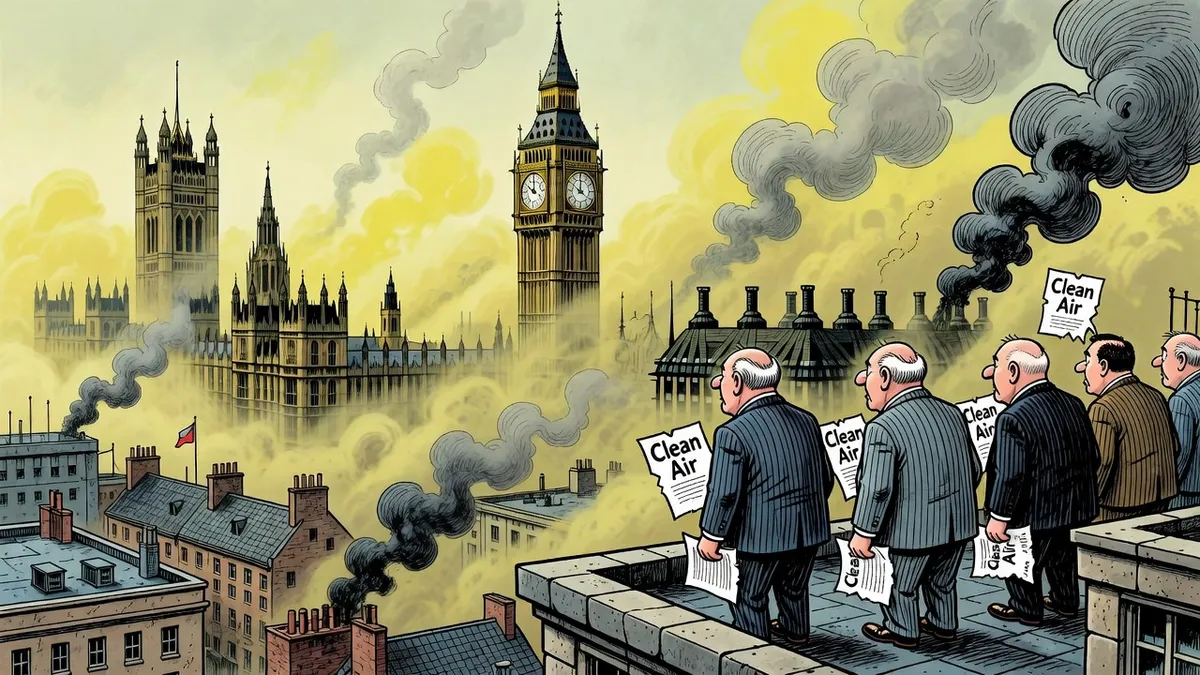
Hillingdon hit 129 micrograms of PM2.5 as monitoring outpaced emission controls
England’s urban monitoring stations recorded fine particle concentrations exceeding eight times the World Health Organization daily guideline during a single foggy period. Hillingdon reached 129 micrograms per cubic metre of PM2.5, with eleven sites across London and Greater Manchester hitting the highest official pollution band. These readings followed a weekend of fireworks and bonfires under still conditions that prevented normal dispersion.
The pattern occurs each year. Domestic wood burning and vehicle emissions supply the base load, then seasonal events add concentrated bursts that fog locks near ground level. Officials issued alerts after the spike, yet the underlying sources continue without interruption.
Predictable spikes, limited response
Government data show particulate matter from transport and home heating already forms the largest steady contribution. Bonfire Night and Diwali simply push totals past safe thresholds when weather cooperates. No binding restrictions halted the additional burning this year.
Clean Air Fund and Global Action Plan representatives noted the same sequence repeats annually. They recommended forecasts and voluntary burn alerts rather than enforced limits on wood stoves or stricter vehicle controls. The gap between repeated monitoring and actual emission cuts remains unchanged.
Health and infrastructure costs
Exposure at these levels links directly to increased heart and lung disease. Residents with existing conditions received advice to stay indoors, but the concentrations affected all exposed populations. Southern and northern cities recorded comparable peaks, indicating the problem is not confined to one region.
Infrastructure for dispersion does not exist. Britain lacks sufficient wind corridors or active filtration systems in dense urban zones. Policy continues to treat pollution as an episodic weather event instead of a controllable output of daily activity.
Institutional continuity
Successive administrations have maintained monitoring networks while domestic burning volumes have risen. Alerts shift responsibility onto individuals without altering the permitted sources. The same sites register extreme readings on similar dates because the regulatory framework has not closed the largest controllable pathways.
This outcome reflects standard practice across UK environmental governance. Data collection improves, public warnings multiply, yet measurable reductions in baseline emissions stall. Ordinary residents absorb the health burden while the sources of particulate matter remain embedded in routine urban life.
Commentary based on Air pollution soars as fog traps emissions in England’s urban areas by Matthew Pearce on the Guardian.
← Back to commentary