Perishables Pile Up Under Post-Brexit Rules
New documentation requirements at Calais expose the lasting efficiency loss from leaving the single market.
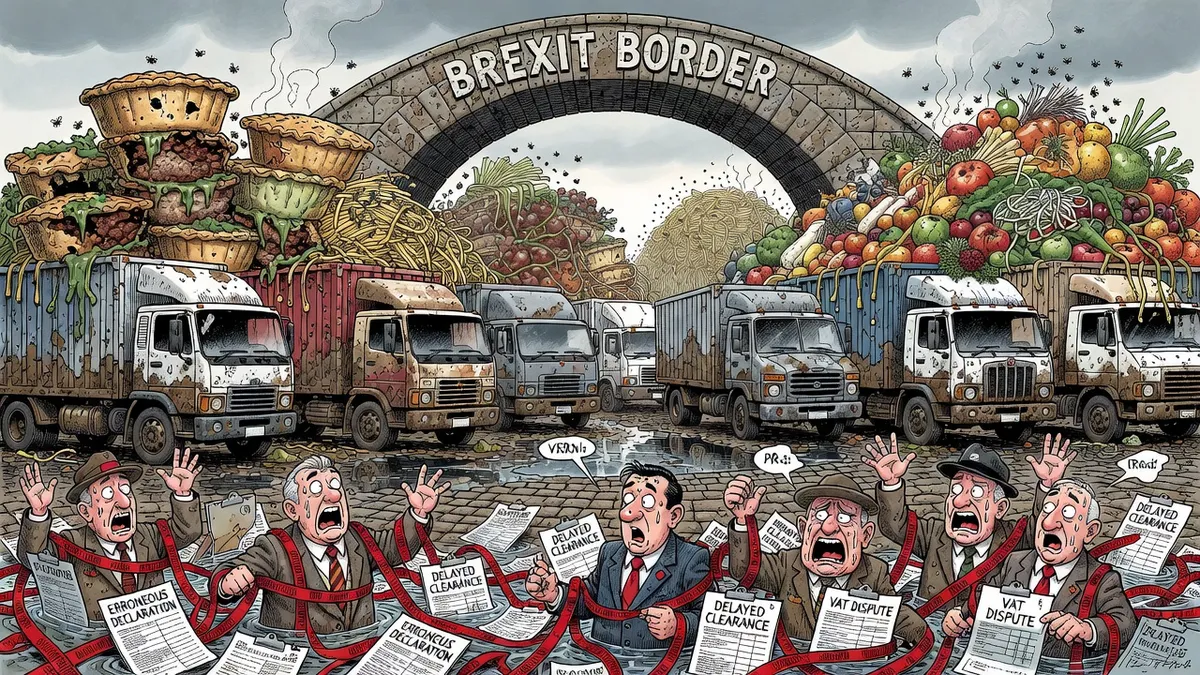
Export costs and delays cut trade volumes 20 percent with no full reversal in sight
Brexit Paperwork Stalls Perishables at Calais
Three boxes of spinach and ricotta cannelloni were pulled from a lorry at the Eurotunnel terminal because the health certificate listed the wrong date. The shipment formed part of a consignment bound for Gibraltar that already carried 78 separate files. Nine hours later the driver waited to resume a 24-hour journey.
These checks did not exist inside the EU single market. Export health certificates now cost £200 each, pre-notification packs add £40, and common user charges run between £80 and £100 per consignment. Full physical inspections can impose further fees of €200 to €700. Small and medium-sized exporters face the heaviest burden, with some abandoning EU markets entirely.
Trade volumes reflect the added friction. Getlink reports a decline of just over 20 percent in both directions across the Channel since 2020. Exports of poultry and eggs have fallen sharply. The Department for Environment, Food and Rural Affairs data confirms that many smaller firms have stopped exporting to the EU altogether.
An SPS agreement expected next year will remove some veterinary certificates. Customs declarations and other declarations will remain. Implementation cannot begin before January 2028 because legislation must first align UK rules continuously with evolving EU standards. Even after that point, border infrastructure built at a cost of €60 million will become partly redundant.
The pattern shows a structural shift rather than a temporary adjustment. Pre-Brexit trade moved without these layers of documentation and inspection. Post-Brexit processes add time, cost and rejection risk regardless of which government holds office. Ordinary businesses absorb the difference through lost sales and higher overheads.
This outcome follows directly from the decision to leave the single market while retaining extensive trade links. The resulting regulatory overhead operates as a permanent drag on volumes and margins. No subsequent agreement has restored the prior level of frictionless movement.
Commentary based on Pasta, pies and paperwork errors: the reality of Brexit food checks by Lisa O'Carroll on the Guardian.
← Back to commentary