£1,972 Bills Follow Gas Doubling from Iran Strikes
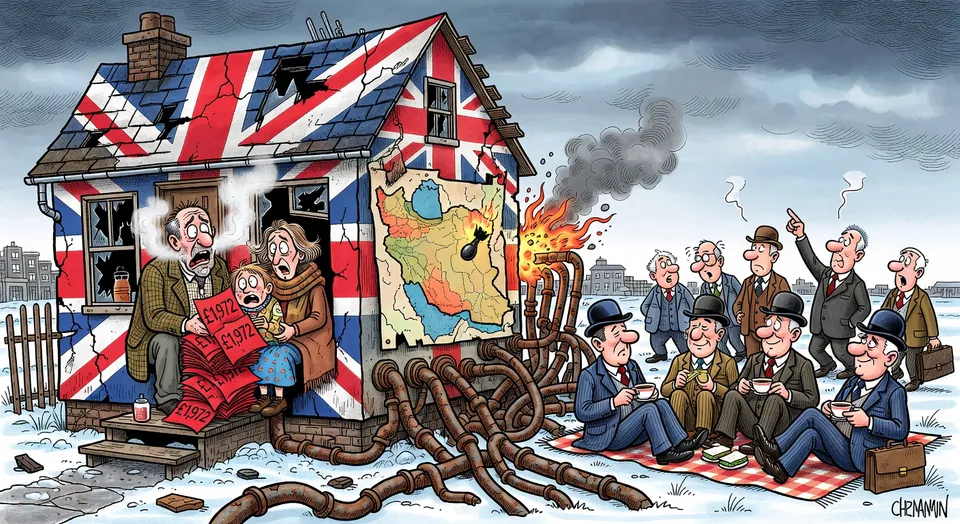
Forecast jumps £331 from current cap as war disrupts imports
Iran conflict doubles UK gas prices, pushing household bills to £1,972 from July. Decades of cross-party energy policy expose import dependence and living standard erosion.
Commentary Based On
the Guardian
Household energy bills in Great Britain ‘could rise to almost £2,000 a year’ amid Iran war shock
Cornwall Insight now projects a typical dual-fuel household bill at £1,972 annually from July. This marks a £331 rise from the current £1,641 price cap and exceeds the consultancy’s £1,800 forecast just two weeks prior. Middle East war escalation, including strikes on Qatar’s largest LNG plant, doubled European gas prices from pre-conflict levels.
UK gas for next month trades at 153p per therm on Friday, down 2% from Thursday’s 180p peak but still double the price before Iran’s involvement intensified. Brent crude hit $107 per barrel after $119 highs, up 50% overall. Petrol reached 143.35p per litre, an 8% jump in three weeks; diesel climbed 15% to 163.73p.
Ofgem set the April-June cap at £117 below the prior quarter, a temporary dip amid long-term ascent. Yet summer forecasts confirm relentless pressure. Households absorb market volatility through the cap, which tracks wholesale costs without shielding from shocks.
Import Dependence Exposed
Britain imports most of its gas, a reversal from North Sea exporter status in the 1990s. Decades of underinvestment in domestic production left reserves depleted. Cross-party governments prioritised net-zero targets over supply security, closing fields and delaying nuclear plants.
Europe’s gas surge stemmed from Hormuz Strait disruptions, controlled by Iran’s Revolutionary Guard. Qatar’s facility faces five-year repairs. UK markets mirror this, with no strategic stockpiles to blunt impacts.
Motorists pay the price at pumps. The 8-15% fuel hikes compound weekly budgets. International Energy Agency calls for Covid-era rationing: lower speed limits, work-from-home mandates, carpooling.
Mortgage Squeeze Compounds Pain
Average two-year fixed mortgage rates rose from 4.83% in early March to 5.35% by Friday. For a £250,000 loan over 25 years, this adds £900 annually. Market bets on Bank of England hikes to 4-4.25% push rates toward 5.5-5.75%, tacking on £1,000-£1,500 more.
Swap rates, underpinning lending, hit year highs despite base rate hold at 3.75%. Bank commentary signals openness to rises amid inflation fears. Households face dual energy-mortgage hits without wage growth to match.
Productivity stagnates at 1997 levels relative to peers. Real wages lag 2008 peaks. Energy and borrowing costs erode living standards further.
Regulatory Illusion Persists
Ofgem’s cap offers no floor against wholesale spikes. It adjusts quarterly to supplier costs, passing volatility directly. Regulators cite market forces, but policy shaped those markets: import reliance, intermittent renewables straining grids.
Previous governments slashed energy efficiency grants. Insulation programmes faltered under austerity then green levies. Vulnerable households, already in fuel poverty, face deepest cuts.
IEA’s emergency playbook reveals global alarm. Britain, once energy independent, now begs for conservation edicts. No domestic response outlined beyond pleas for tariffs.
This £330 summer bill surge atop doubled gas exposes structural frailty. Cross-party neglect turned abundance into vulnerability. Ordinary citizens fund elite policy failures through squeezed budgets, as institutional safeguards prove fictional. Decline embeds deeper with each import-dependent crisis.
Commentary based on Household energy bills in Great Britain ‘could rise to almost £2,000 a year’ amid Iran war shock by Jillian Ambrose on the Guardian.