Quantum Cash Chases Exiled Talent
Rachel Reeves vows to halt UK tech drift with major investments, but history shows pledges fail against superior US incentives and weak domestic markets. Cross-party inaction perpetuates talent loss amid energy shocks.
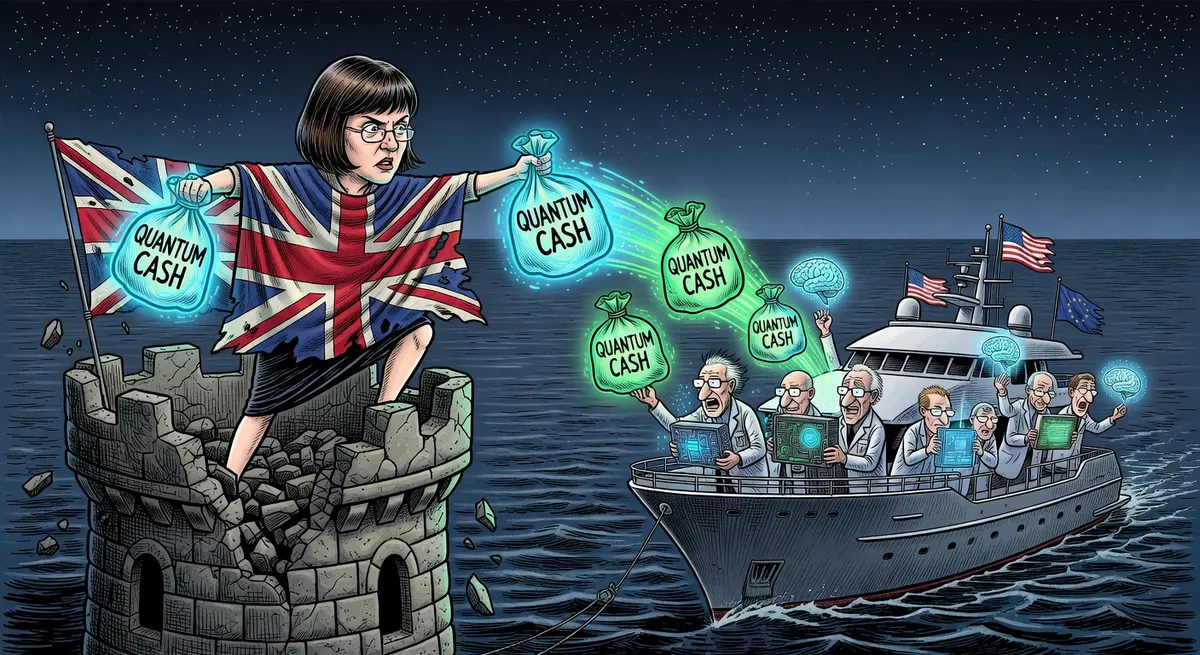
£2.5 billion pledge ignores decade of firm relocations and capital gaps
Reeves allocates £2.5 billion to quantum and AI amid ongoing exodus of UK tech firms to the US. Top startups routinely relocate for better capital access and tax incentives. Government vows mask a decade-long pattern of talent and enterprise loss.
UK tech founders build here, then shift headquarters abroad. Phasecraft’s CEO notes high-profile acquisitions by US giants and easier overseas funding. London Stock Exchange listings yield lower valuations than Nasdaq equivalents.
Pension funds and government investment lag far behind US venture capital. In 2024 alone, UK deep-tech firms raised £3.4 billion domestically, dwarfed by America’s £50 billion. Firms like Graphcore and Oxford Nanopore fetched billions more post-relocation.
Reeves pitches stability and an “active state” to reverse this. Her Mais Lecture promises 100,000 quantum jobs and G7-leading AI adoption. These targets build on £1 billion already committed pre-election.
Yet external shocks undermine the plan. US-Israel-Iran conflict spikes oil prices, with Strait of Hormuz disruptions looming. Reeves defers North Sea decisions like Rosebank to “across government,” despite calls to drill amid inflation risks.
Energy ties with EU form another pillar. Post-Brexit reset integrates UK into European markets, easing prices. Wider alignment in chemicals and manufacturing signals further regulatory convergence.
Cross-Party Continuity
Conservatives label this a Brexit reversal, as Labour blames prior policy for economic woes. Both sides oversimplify: tech drift predates 2016, accelerating under Tory inaction on taxes and listings. Labour’s 2024 manifesto ignored LSE reform.
Pre-2010 Labour governments watched ARM Holdings list in New York for superior terms. Post-Brexit, 60% of UK unicorns eyed US moves per Scaleup Institute data. Interventions recycle without addressing root capital shortages.
Quantum investments echo 2013’s £200 million national initiative, now scaled up. Outputs remain modest: UK holds 10% of global quantum patents but captures 2% of venture funding. Firms still acquire talent abroad.
Systemic Retention Failures
Tax breaks lure firms to Ireland and Delaware. UK’s 19% corporation tax trails effective US state rates post-deductions. Pension rules cap deep-tech allocations at 5% of funds.
Regional devolution promises cluster growth outside London. Yet Oxfordshire’s Quantum Computing Centre hosts visiting ministers, not relocated HQs. Scientists follow firms: 4,000 UK AI PhDs emigrated since 2020.
Brexit compounded frictions, but Labour’s EU alignment revives old dependencies. Food standards reset removes red tape, yet chemicals alignment risks sovereignty trade-offs. Growth stays sluggish at 1.1% forecast for 2026.
This reveals institutional sclerosis in high-value sectors. Governments pledge billions, firms depart anyway. UK economy forfeits compound gains as talent compounds abroad.
Britain’s tech edge erodes through repeated half-measures. Reeves recites familiar scripts amid verifiable outflows. Decline embeds when power centres prioritize announcements over ecosystem overhauls.
Commentary based on Reeves vows to stop UK tech from 'drifting abroad' at BBC News.
← Back to commentary