Royal Mail's Permanent Contracts Meet Self-Employed Competition
Former minister warns of viability risk as 98 percent of Royal Mail staff remain permanent amid uneven employment rules and repeated missed targets.
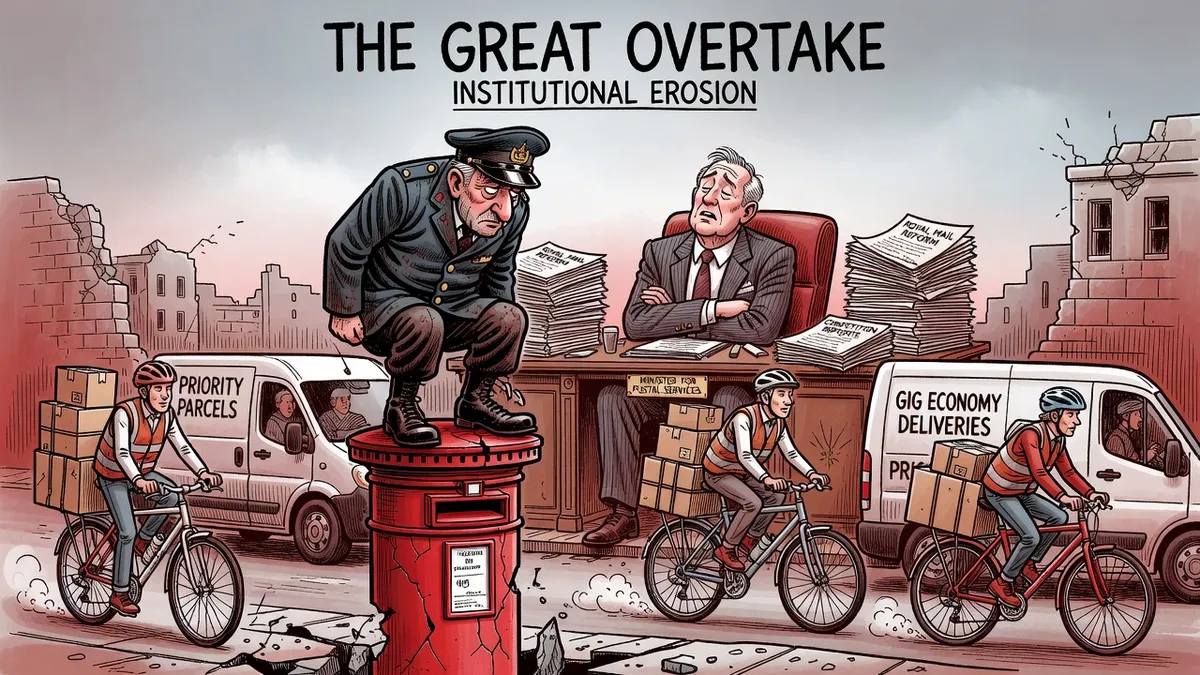
Universal service duties persist while parcel rivals avoid equivalent labour costs
Royal Mail requires its 130,000 staff to operate under permanent contracts that include pensions, sick pay and holiday entitlements. Rival parcel firms route work through self-employed drivers who carry none of those obligations. The resulting cost gap has widened as letter volumes fell and fines for missed targets reached £21 million in 2025.
Former business secretary Peter Kyle began preparing a review of these market conditions before his removal in July. The review would have examined where profits accumulate in parcel delivery and whether employment standards were being undercut. No such review has been completed.
Universal obligations remain fixed
Royal Mail must deliver first-class letters six days a week to every UK address at a single price. Ofcom has already lowered the first-class on-time target to 90 percent and removed the second-class Saturday requirement. These adjustments have not prevented further complaints from MPs about delayed and missed deliveries.
The company recorded performance improvements in recent months yet still failed its regulatory benchmarks. Management bears responsibility for execution shortfalls, as opposition spokesmen have noted. At the same time the statutory duties and labour model stay in place while competitors operate without them.
Delayed government response
A Department for Business and Trade consultation on bogus self-employment opened after Kyle left office. Officials now state they will examine further parcel-market reforms only after Ofcom releases its December monitoring report. The timeline places any potential action well after the point Kyle described as a crunch.
The Communication Workers Union has called for a new ownership model. Ministers have met the company and union but offered no concrete changes to universal service rules or employment enforcement. Previous attempts to address these structural imbalances produced no binding outcome.
Pattern of institutional lag
Britain’s postal network now operates under rules designed for a different era of volume and competition. Successive governments have preserved the universal obligation while permitting labour-cost arbitrage elsewhere in the sector. The result is predictable: higher fixed costs for the designated provider, repeated regulatory penalties, and growing public dissatisfaction with basic service reliability.
This arrangement leaves ordinary users paying rising prices for declining performance. It also leaves 130,000 workers exposed to the consequences of sustained undercutting that regulators have so far declined to correct.
Commentary based on Government must act now or lose Royal Mail, former minister Peter Kyle warns at BBC News.
← Back to commentary