SEND Rights Hinge on Transition Reviews
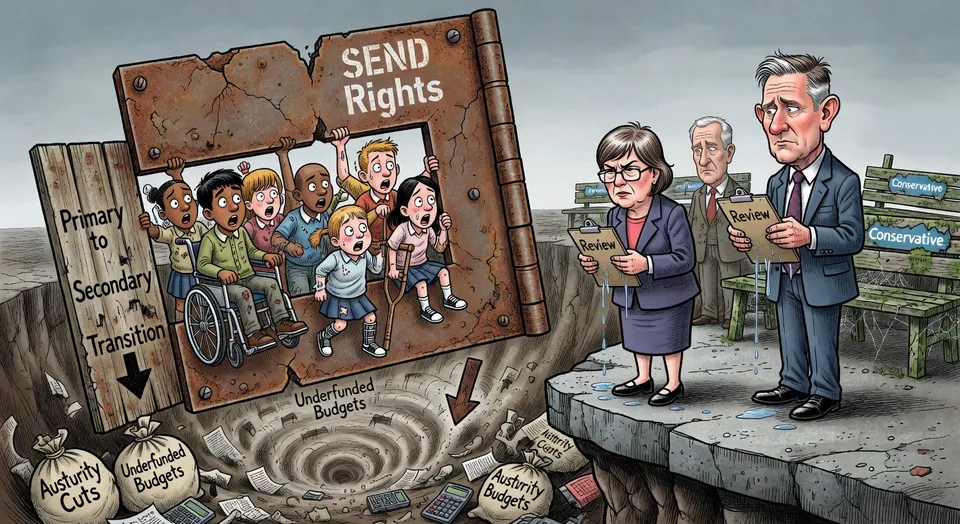
482,000 EHCPs face reassessment at secondary entry amid £6bn shortfall
Labour's leaked SEND overhaul reviews legal rights for every child at school transitions, rationing support to control costs despite rights-expansion claims. This caps bipartisan neglect of vulnerable pupils.
Commentary Based On
BBC News
Pupils' SEND support to be reviewed after primary, leaked plans suggest
Leaked plans mandate reassessment of every child’s Education, Health and Care Plan (EHCP) at the shift from primary to secondary school starting 2029. These legal documents currently guarantee support for 482,000 pupils, or 5% of England’s school population. Government spokespeople call this an expansion of rights, but the mechanism ensures fewer retain full EHCP protections.
EHCPs cover speech therapy, mental health access, and teaching assistants tailored to individual needs. Parents endure years of battles with councils, often funding private assessments and tribunal appeals. Last year saw a surge in applications as reform fears mounted.
The overhaul introduces school-led Individual Support Plans (ISPs) for all 1.76 million SEND pupils, including the 1.28 million without EHCPs. ISPs gain legal status, but details remain vague on enforcement. Officials promise earlier intervention to avert costlier needs later.
Cost Containment Drives the Shift
Rapidly rising expenses force the change. Councils face a £6 billion shortfall by 2028, per the Office for Budget Responsibility, with spending shifting to central government. A £60,000 annual cap on independent sector fees aims to curb outsourcing.
Total EHCP recipients hit 639,000 when including over-25s and non-school cases. Demand triples the proportion of SEND children served compared to a decade ago. Local authorities ration via delays and denials, pushing families to courts.
Reassessments occur at every phase: primary to secondary, secondary to college. Expert panels decide “Specialist Provision Packages” under national standards. EHCPs survive only for the most complex cases, diluting current entitlements.
Charities flag risks. Autistic pupils falter at transitions, where stability matters most, warn Ambitious about Autism and Sense. The National Autistic Society decries leaked drip-feeding as disrespectful to anxious parents.
Headteachers note the system’s dual failures: unmet child needs and school overloads. Paul Whiteman welcomes potential relief if funded properly. Yet no plan addresses the funding gap.
Bipartisan Roots Run Deep
SEND debts reached £18 billion by overrides since 2014, hidden across Tory and Labour tenures. Councils deferred payments, eroding school budgets. Statutory instruments masked the scale until exposure.
Labour centralises control post-2028, echoing past nationalisations that postponed accountability. Criteria tighten into three tiers: Targeted, Targeted Plus, Specialist. Mainstream inclusion ramps up with teacher training and school units.
This repeats institutional patterns. Promises of inclusion date to 2014 reforms, yet delivery faltered under both parties. Tribunals processed 13,000 appeals in 2023, with parents winning 98%—a damning verdict on local provision.
Vulnerable children bear the cost. Instability mid-transition disrupts progress for those with autism or trauma. Broader SEND cohort gains paper plans, but without robust rights, schools lack resources to deliver.
Political risks loom. Starmer’s weakened position invites Labour backbench revolt if protests flood inboxes. Liberal Democrats demand total overhaul, not tweaks.
Labour’s white paper pledges needs-led support in communities. History shows such ambitions crumble without cash. The £6 billion hole persists, forecast to widen.
SEND exposes core governance rot. Cross-party neglect built a crisis where 639,000 entitlements face routine scrutiny, rationing aid to the desperate few. Britain’s vulnerable pay for systemic fiscal denial, as politicians repackage failure as reform.
Commentary based on Pupils' SEND support to be reviewed after primary, leaked plans suggest at BBC News.