Starmer Drafts Exit Speech as Colleagues Allocate Posts
Internal positioning for a Burnham transition reveals how authority transfers without reference to voters or manifesto commitments.
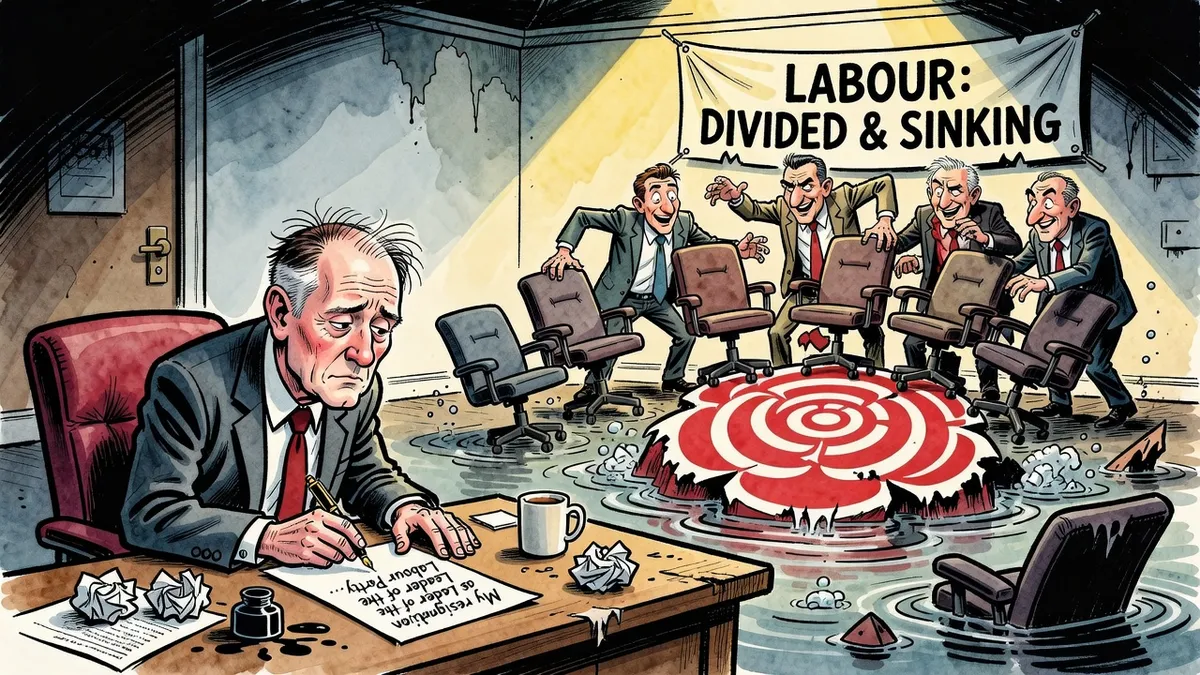
Newspaper reports place resignation preparations ahead of any public vote or formal process
Labour’s leadership transition has shifted from speculation to preparation within days. Multiple newspapers report Sir Keir Starmer drafting a resignation speech for delivery outside Downing Street, while cabinet ministers describe a sudden internal shift that leaves no room for reversal. The accounts place the prime minister in effective isolation, speaking to almost no one beyond his wife.
Internal Positioning Accelerates
The Times records former Transport Secretary Louise Haigh soliciting job preferences from Labour MPs for roles under a potential Andy Burnham administration. The i Paper adds that Wes Streeting directly requested the chancellorship during Burnham’s Makerfield campaign on 8 June. These moves occurred before any formal vacancy exists.
The Telegraph notes Burnham’s preference for a September handover to assemble policy and personnel. The Mirror’s front page frames the outcome as settled with the headline “Game Over,” accompanied by an image of Starmer alone in an empty stand. Such coverage treats the prime minister’s departure as procedural rather than conditional.
Policy Pressures Surface Immediately
The Daily Mail reports left-wing MPs urging Burnham to abandon manifesto commitments on income tax and VAT to fund new spending. The same paper’s editorial demands a general election to secure public consent for any new direction. These demands appear before Burnham holds any formal position.
The Sun states that Starmer and Burnham have not spoken since the Makerfield result, with the prime minister described as furious. A Labour MP quoted in the paper observes that recruitment for a paid intern now exceeds the scrutiny applied to candidates for the country’s highest office.
Pattern of Authority Erosion
Britain’s constitutional arrangements contain no automatic process for removing a prime minister who has lost internal support. The current sequence shows authority draining through media reports and private conversations rather than through votes or formal votes of confidence. Successive governments have operated under similar conditions since the 2010s, each exiting through internal pressure rather than electoral verdict.
This episode follows documented shortfalls in delivery on growth, public service standards, and fiscal targets. The speed of repositioning indicates that personal networks inside the party now determine outcomes faster than manifesto pledges or parliamentary majorities.
The mechanics remain consistent across administrations. A leader loses the capacity to command colleagues, external actors begin allocating future roles, and the public receives no direct say until the next scheduled election. No structural change has interrupted this sequence in successive parliaments.
Commentary based on Newspaper headlines: 'Starmer expected to announce exit' and 'Game over' at BBC News.
← Back to commentary