Sustainable Farming Cash Exhausts in Six Hours, Shutting Out Thousands
Fixed budgets and first-come allocation leave post-Brexit farm support unable to match recorded needs or legal targets.
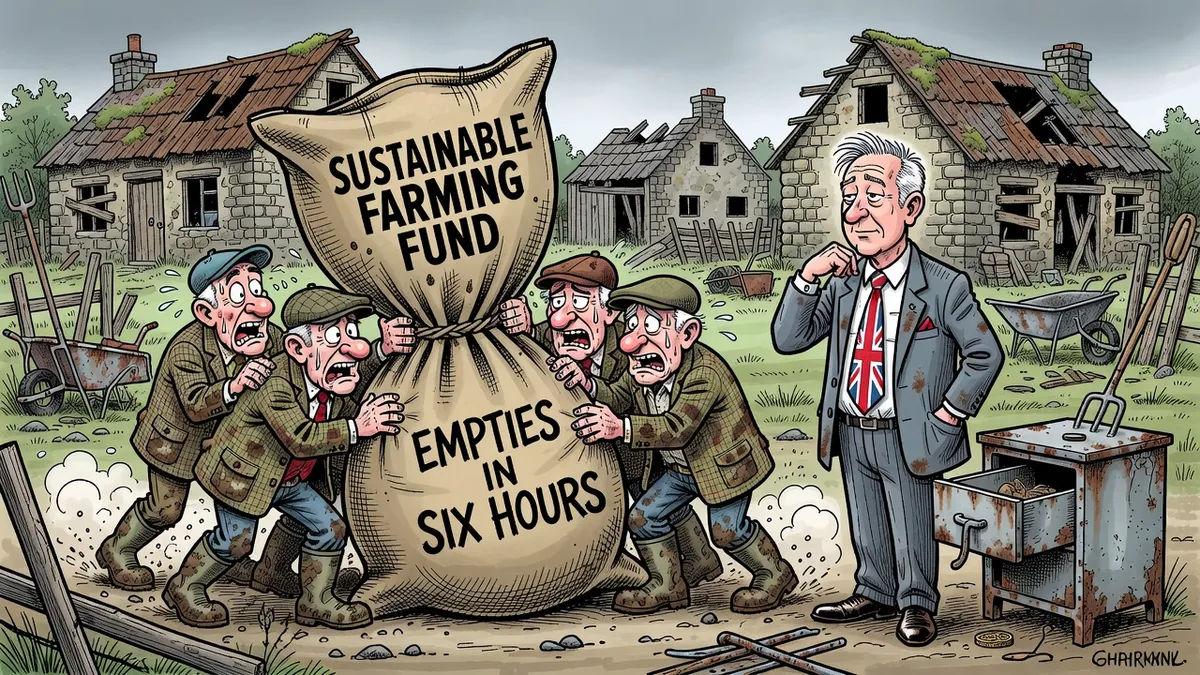
£253m SFI round closes before most applicants reach support lines
The £253 million sustainable farming incentive budget for 2026 was fully allocated six hours after applications opened at 10am on a Tuesday. Thousands of farmers received nothing despite documented needs from heat damage, drought losses, and fertiliser price spikes. The next application window opens in 2027.
This first-come, first-served mechanism replaced the structured payments under the EU common agricultural policy. No prioritisation system existed beyond an earlier limited window for small and new entrants. Demand exceeded supply within a single working day.
Planning Shortfalls
Defra added £70 million in total during the year, including £20 million on the day itself. Officials still could not match the volume of applications. Waiting times for application support reached five hours, pushing many farmers past the closure point.
The scheme was intended to deliver measurable environmental outcomes on soil, water, and biodiversity. Instead it operated as a lottery with fixed resources. Environmental groups noted the outcome directly undermines statutory targets, including the 30 per cent nature restoration goal by 2030.
Farmer Conditions
Farmers entered the process after what the NFU described as the toughest summer in a generation. Crop failures and input costs created immediate cash-flow pressure. The SFI payments were positioned as a route to longer-term resilience, yet the majority of applicants will now operate without that support until at least 2027.
The pattern shows repeated underestimation of uptake. Earlier closures in 2025 already restricted access. No mechanism adjusted the budget envelope in response to recorded farm-level data on weather and cost shocks.
Systemic Outcome
Post-Brexit agricultural policy has produced a smaller, more volatile funding stream than the previous EU framework. Delivery relies on annual competitive rounds rather than multi-year agreements. This structure concentrates risk on individual businesses while environmental delivery becomes contingent on administrative speed.
The result is reduced capacity to meet both production stability and legal nature targets. Ordinary farm operations face higher uncertainty over income streams that were previously more predictable. The gap between stated policy objectives and available resources continues to widen without structural correction.
Commentary based on ‘Worse than the scramble for Oasis tickets’: England’s sustainable farming funds run out in just six hours by Pippa Neill on the Guardian.
← Back to commentary