Therapy Notes Enter Shared NHS Records Without Explicit Consent
A single patient's discovery exposes default data sharing that bypasses consent for psychotherapy details across multiple trusts.
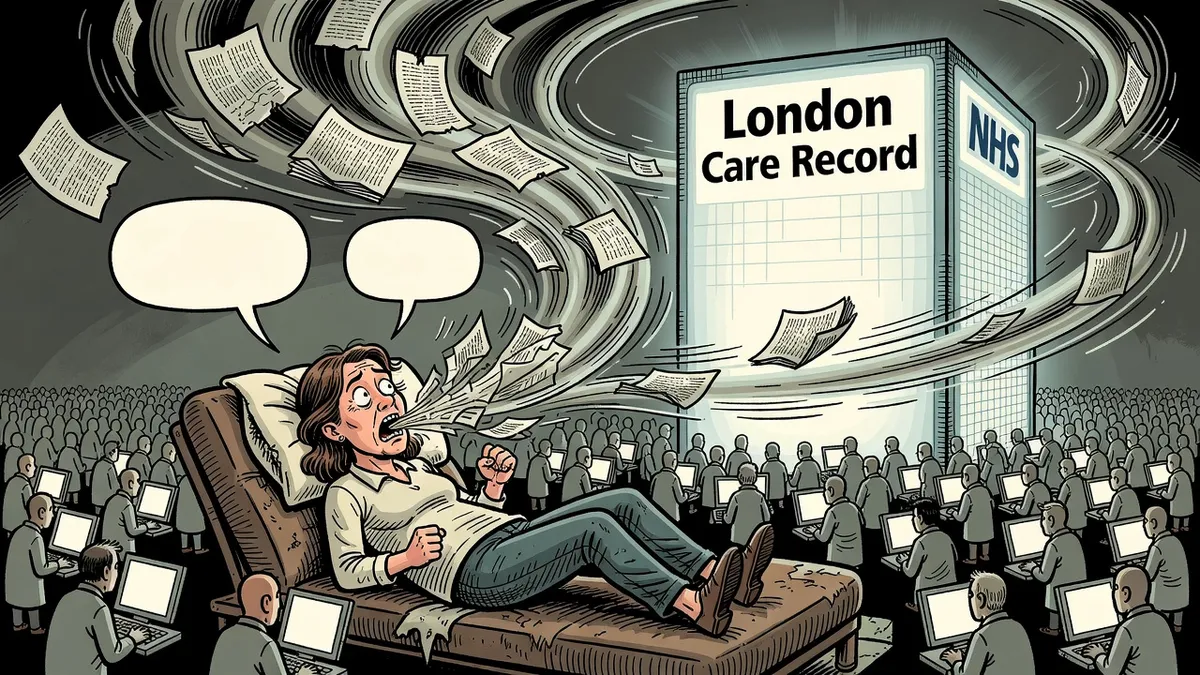
Automatic uploads place session content on the London Care Record for up to 140,000 staff
A patient discovered her psychotherapy notes detailing grief and trauma displayed on a GP screen, exposing them to the London Care Record accessible by up to 140,000 NHS staff.
Rosanna had received no prior notification that session content from South London and Maudsley NHS trust would enter this system. Freedom of information inquiries confirmed access by personnel outside her treating trust. She halted treatment for bipolar disorder as a direct result.
The trust later admitted that key session content uploads automatically. It maintains that no intimate details were shared, yet its own documentation lists all events from child and adolescent mental health services as included. Rosanna received no option to limit or exclude this material.
Data Handling Failures
The Information Commissioner’s Office opened an investigation after parliamentary questions on the case. South London and Maudsley has yet to respond to her subject access request submitted in September. Clinicians hold the technical ability to restrict visibility, but the default process places content into the wider record.
Guidance from ministers states that records relating to direct care move on implied consent. This framework omits any requirement to inform patients specifically about psychotherapy content reaching tens of thousands of staff. The same approach will apply under the proposed single patient record.
Patient Consequences
Rosanna lost secondary mental health support during a family bereavement. She identified safety risks where trauma details reach unauthorised hands. Similar exposure affects other patients, including children, whose records enter the same system without separate safeguards.
The trust acknowledges that staff and patients may not have received enough information on sharing practices. Its chief medical officer cites options to mask parts of records, yet these controls were not applied or communicated in this instance.
This incident fits a pattern of NHS data systems prioritising broad access over granular consent controls. Previous expansions of shared records have repeatedly produced unauthorised viewing incidents without corresponding accountability measures. Mental health treatment depends on assured confidentiality that current upload defaults undermine.
The absence of routine opt-out mechanisms and delayed responses to patient inquiries leaves individuals to discover breaches only through chance encounters. Functional systems would require explicit consent for sensitive therapy content and immediate audit trails for every access. Current arrangements deliver neither.
Commentary based on Patient ‘horrified’ to find her sensitive discussions were shared with more than 100,000 NHS staff at the Guardian.
← Back to commentary