Britain Hands Households the Bill for Energy Policy Shortfalls
Energy costs hit £1,999 annually while policy leaves households to manage volatility through individual adjustments rather than secure supply.
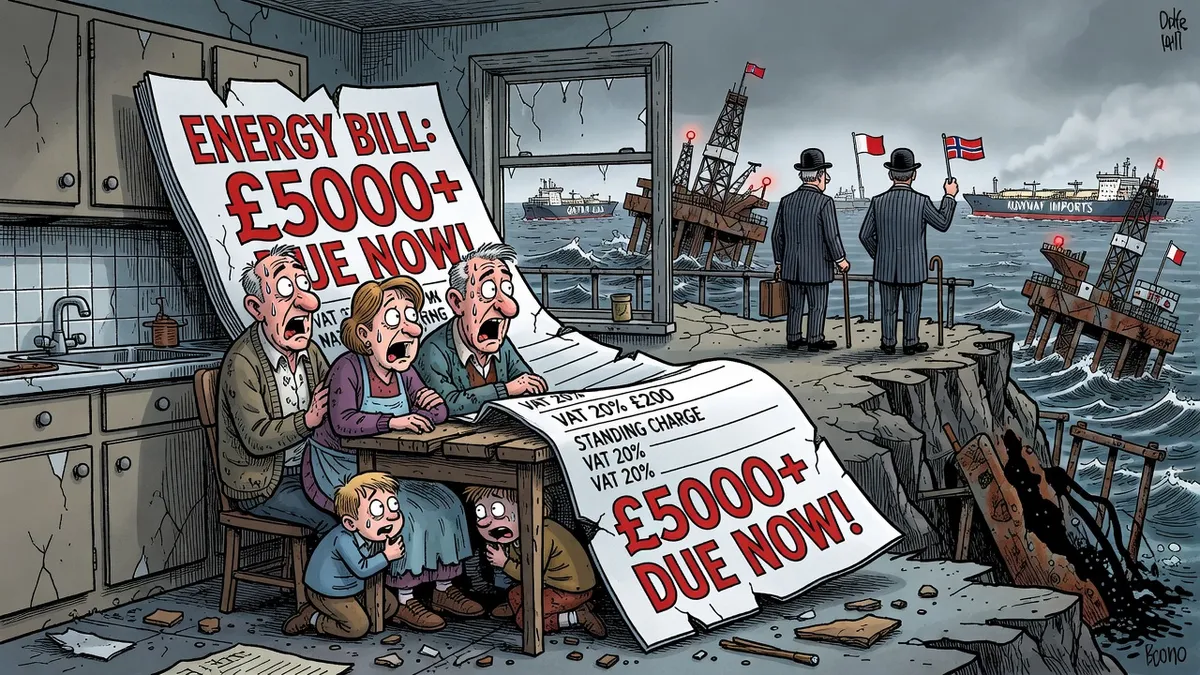
Price cap forecasts reach £1,999 as personal insulation advice substitutes for generation capacity
Britain’s energy regulator has set a price cap trajectory that will push the typical dual-fuel bill to £1,999 a year by January. The figure represents a £276 annual increase from current levels, driven by wholesale gas costs that domestic production no longer offsets. Official commentary frames this as a household management challenge rather than a supply and policy failure.
The Guardian piece lists practical steps including fixed tariffs, boiler flow temperature reductions, draught stripping, and loft insulation. These measures can trim tens or hundreds of pounds for some homes. They do not address the underlying price level or its trajectory.
Policy substitution for infrastructure
Successive governments have closed coal and reduced nuclear capacity while increasing reliance on imported liquefied natural gas. The resulting exposure appears in every price spike. Individual insulation grants and heat pump subsidies exist, yet uptake remains low because upfront costs and electricity tariffs often exceed savings for average households.
Heat pump recommendations in the article note the need for dedicated time-of-use tariffs to avoid higher bills. This requirement reveals the mismatch between the technology and the current grid pricing structure. Households without those tariffs face the efficiency penalty the article acknowledges.
Accountability and outcomes
The price cap itself was introduced to protect consumers after earlier market liberalisation. Forecasts from Cornwall Insight show it rising 16 percent in January alone. No minister or regulator faces direct consequences for the cumulative gap between promised affordability and delivered prices.
Data on actual bill arrears and disconnection rates are tracked separately from these forecasts. The pattern repeats across energy, water, and rail: regulated monopolies pass through costs while service standards stagnate.
Living standards measurement
Annual energy expenditure nearing £2,000 absorbs a larger share of median household income than in peer European countries with greater domestic generation. Official statistics record real wages flat or declining in multiple sectors since 2022. The combination produces measurable compression in discretionary spending without requiring partisan interpretation.
The article’s focus on consumer actions leaves the structural question unexamined. Functional energy policy would align generation capacity, storage, and transmission with demand at stable unit costs. Current outcomes show the opposite trajectory sustained across multiple administrations.
Britain’s households now absorb price volatility that earlier domestic production once buffered. The shift from collective infrastructure adequacy to individual coping strategies documents the measurable retreat in state capacity.
Commentary based on Energy bills: what to do as prices head for £2,000 a year, from switching deals to insulating by Zoe Wood on the Guardian.
← Back to commentary