Britain Withdraws Funding From Lovell Telescope
The agency prioritises future projects while terminating a working national facility and its training role.
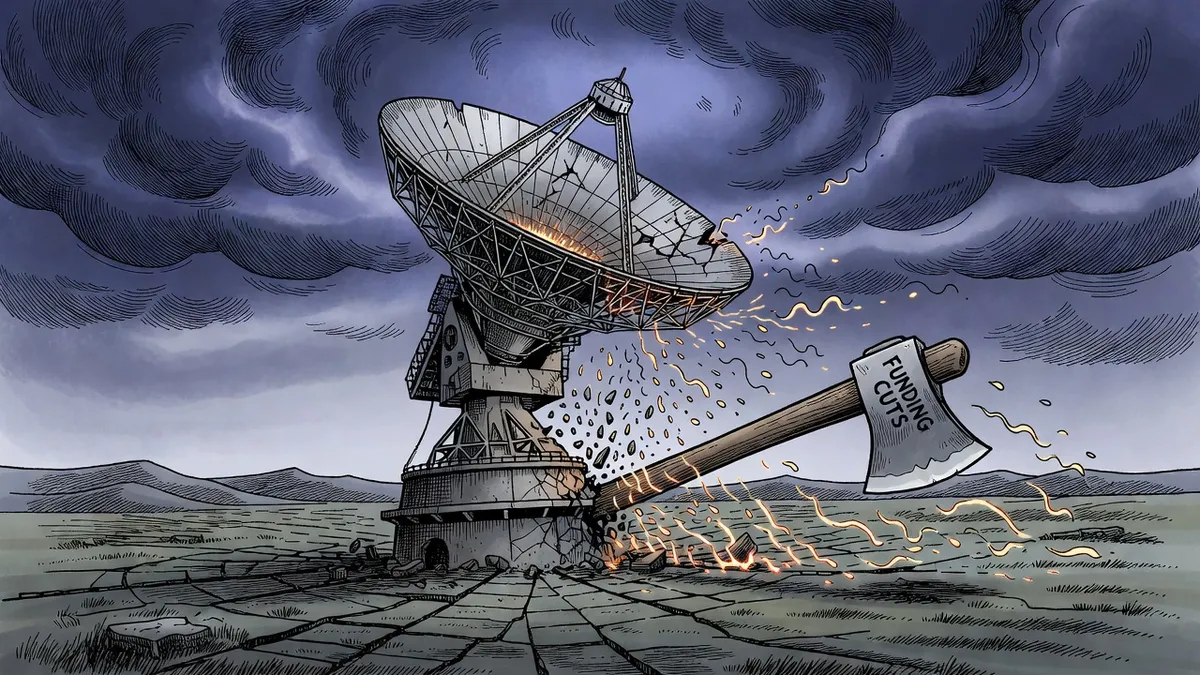
UKRI ends £2.8m grant to Jodrell Bank from 2028 amid wider astronomy cuts
Britain has withdrawn support for the Lovell telescope at Jodrell Bank Observatory. Operations will end on 1 April 2028 unless replacement funds appear. The decision removes the UK’s largest radio telescope from service after nearly seventy years of continuous use.
The UK Research and Innovation agency cited rising costs in physics and laboratory operations as the reason for the cut. Its annual grant to the site stood at £2.8 million. UKRI holds a budget near £10 billion yet chose to end support for this facility and several other astronomy projects.
Loss of Established Capability
Jodrell Bank opened in 1945 and developed techniques that defined radio astronomy. The Lovell telescope remains the third-largest steerable dish in the world and forms the core of the e-Merlin network. That network delivers resolution comparable to the Hubble space telescope for studies of galaxy evolution, star formation and dark matter.
The same cuts remove UK participation in the James Clerk Maxwell Telescope in Hawaii and instruments on the Extremely Large Telescope under construction in Chile. Upgrades to experiments at the Large Hadron Collider also lose funding. Twenty-eight posts at Jodrell Bank face direct risk, while nearly three thousand researchers who rely on the site lose access.
Training and International Standing
Jodrell Bank has trained generations of radio astronomers. Its closure removes the primary UK route into that discipline just as the Square Kilometre Array begins operations in South Africa and Australia. Other nations are expanding their own facilities in preparation for that project.
Scientists at Manchester University and partner institutions describe the move as removal of national capability rather than routine budget adjustment. The observatory holds UNESCO World Heritage status and continues to attract school and university visitors to science and engineering careers in the north-west.
Pattern of Stated Priorities
Ministers repeat that world-class research sits at the centre of future growth. UKRI states it must concentrate resources on projects with the greatest long-term impact. The outcome is simultaneous withdrawal from existing instruments and reduced preparation for the next generation of facilities.
The gap between funding announcements and operational cuts has appeared before. Laboratories report grant pauses and project cancellations even while headline science budgets rise on paper. Institutions lose experienced staff and institutional memory when established sites close without transition plans.
This removal of an operational radio astronomy network leaves Britain without domestic capacity in a field it once led. The infrastructure, training pipeline and data access all contract at the same time other countries expand theirs. The decision records a further contraction in the country’s scientific base rather than its maintenance or renewal.
Commentary based on Jodrell Bank's Lovell telescope faces axe in science cuts, BBC understands at BBC News.
← Back to commentary