British Library Converts Public Desks Into Private Offices
The British Library closes reading rooms and outsources guards to generate revenue, despite DCMS investment in the same facilities.
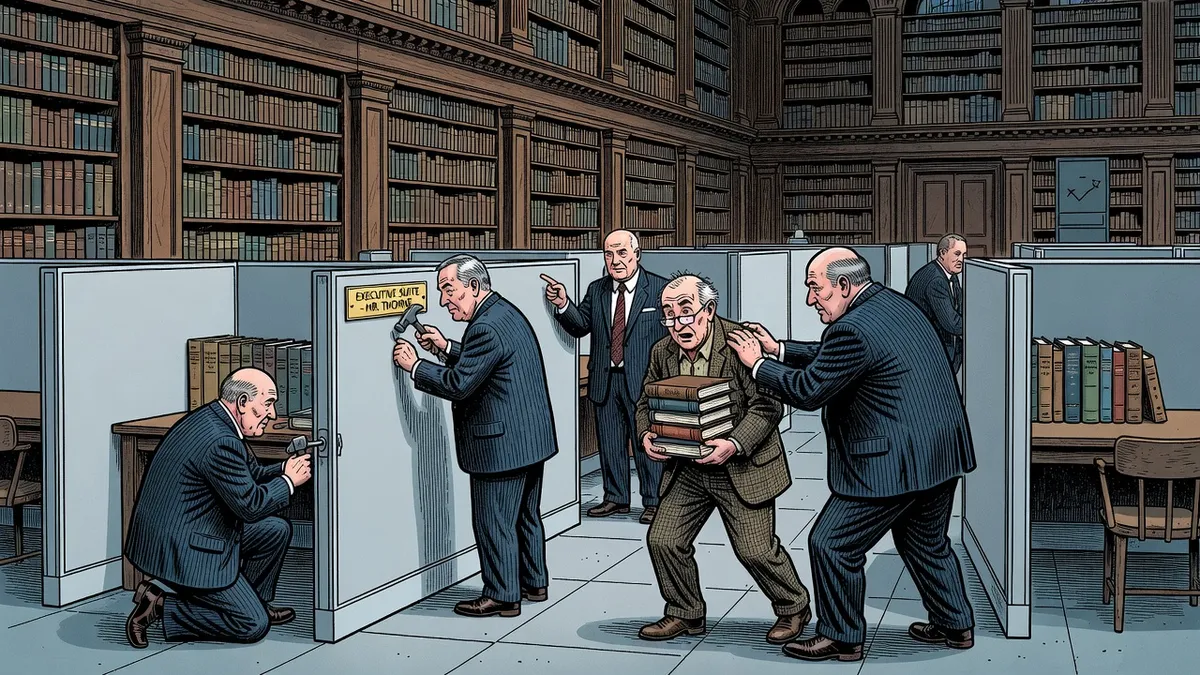
Three reading rooms and seventy security posts shift to commercial use after public refurbishment funding
British Library Reduces Public Access to Fund Commercial Tenants
The British Library intends to close three of its eleven reading rooms at the St Pancras site and convert them into privately operated business workspaces. This move follows reports of up to £14 million in public funding allocated by the Department for Digital, Culture, Media and Sport for refurbishment of those same spaces. The change will remove an estimated 340 reader desks from a total of more than 1,400.
Security operations covering the entire site will transfer to the contractor STM on 1 December. Nearly seventy guards, supervisors and managers face the transfer. STM has already declined to recognise the PCS union for the incoming staff.
The library states that in-person visits have declined and that it faces a £7 million operating deficit this year. It argues that revenue from flexible workspace will sustain free core services. Internal documents indicate fit-out costs for the new spaces range between £8 million and £13 million.
Reduced Capacity and Public Access
Current demand already exceeds available desks on many days. The proposed reduction removes roughly one-fifth of existing reading room capacity at the main London site. The library holds more than 150 million items and serves researchers, students and independent scholars who rely on physical access.
The library attributes lower footfall to changing research habits and a prior cyber incident. It has not published data showing whether capacity constraints themselves have contributed to reduced visits.
Outsourcing Despite Policy Commitments
The transfer of security staff contradicts the government’s pre-election pledge to deliver the largest wave of insourcing in a generation. The PCS has written to culture secretary Lisa Nandy requesting intervention. The union notes that public money is being used to prepare facilities that will then be handed to a private operator without union recognition.
The library has refused to rule out future redundancies or restructuring. No immediate job losses have been confirmed, yet the closure of reading rooms and the loss of hundreds of desks make staffing reductions difficult to avoid.
Revenue Over Public Function
The library website cites strong demand for high-quality workspace in London as justification. It presents the commercial conversion as necessary to protect free access to remaining services. This approach treats public research facilities as under-utilised assets available for monetisation rather than maintained infrastructure.
Similar pressures appear across other publicly funded cultural bodies facing flat or declining grants. The pattern shows institutions shifting from open public provision toward revenue-generating activities that restrict access for non-paying users.
The decision reveals how resource allocation now operates inside core national institutions. Public funds refurbish space that is promptly reassigned to commercial use, while staffing is moved to contractors that reject collective bargaining. Ordinary researchers lose desks; the library gains income; accountability for the original public investment remains unaddressed.
Commentary based on British Library to outsource security and ‘repurpose’ reading rooms as business spaces by Dalya Alberge on the Guardian.
← Back to commentary