Dockless Ebikes Expose London’s Patchwork Enforcement Limits
Seizure data shows private rental growth outrunning regulatory capacity, with vulnerable pedestrians bearing the direct costs.
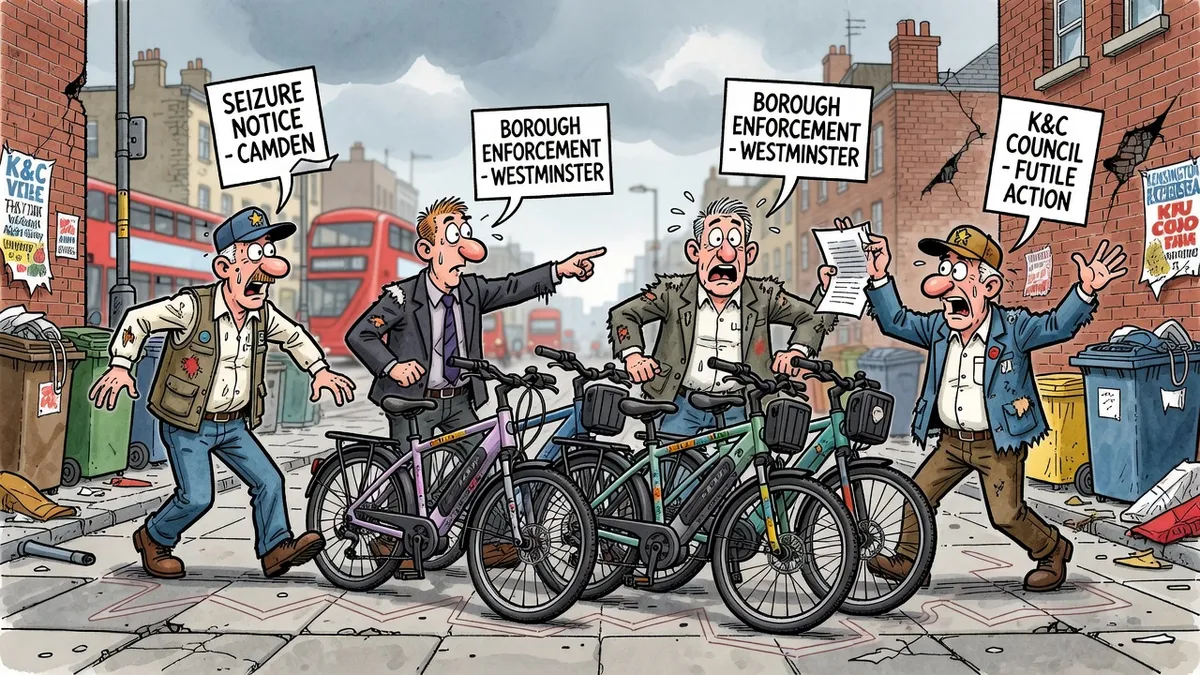
3,393 seizures in 2025 highlight coordination failures across 32 boroughs
London boroughs removed 3,393 dockless ebikes from streets this year, a 23 percent rise on the full-year total for 2025. Lime accounted for more than 2,000 of those seizures across 19 reporting authorities, with Forest and Voi following at 978 and 103 respectively. The removals target vehicles left blocking pavements and parking bays.
Nineteen of 22 contacted London authorities supplied data through freedom of information requests. Nine others reported no seizures at all. This patchwork response matches the fragmented contracts that allow operators to run services across borough boundaries with differing rules.
Operators attribute the build-ups to insufficient designated parking bays. Councils counter that private firms expand fleets without coordinating capacity. Both positions leave the documented obstructions in place, with blind and mobility-impaired residents reporting collisions and reduced independent travel.
The English devolution bill, passed in April, assigns new licensing powers to Transport for London. Secondary legislation is still required to create a single regulatory framework. Until then, 32 boroughs continue separate policies that operators describe as a jigsaw puzzle.
One in ten of London’s 1.5 million daily cycle journeys now uses dockless ebikes. The same expansion that produces these volumes also generates the hazard reports that trigger seizures. No authority has published figures showing how many seized vehicles return to service or how quickly.
Regulatory Fragmentation
The absence of uniform standards allows operators to maintain high fleet numbers while shifting responsibility for parking failures onto local infrastructure. Councils lack the coordinated enforcement tools that would compel consistent compliance across the capital. The result is repeated seizures without measurable reduction in pavement obstructions.
Accessibility Impacts
Campaigners document cases where abandoned bikes prevent wheelchair users and visually impaired pedestrians from using pavements. Some individuals report abandoning solo journeys altogether. These outcomes occur under the same policy environment that promotes dockless schemes as accessible transport options.
The seizures record the measurable cost of rapid private expansion without matching public coordination. London’s governance structure continues to deliver incremental adjustments rather than integrated control over street space. Ordinary residents absorb the daily friction of obstructed routes while operators and authorities negotiate future rules.
Commentary based on Thousands of ebikes seized by London councils as anger rises over blocked paths by Lauren Almeida on the Guardian.
← Back to commentary