Millisecond Defect Grounds UK Flights for Days
A single software corruption in the National Airspace System triggered nationwide restrictions and multi-day passenger disruption.
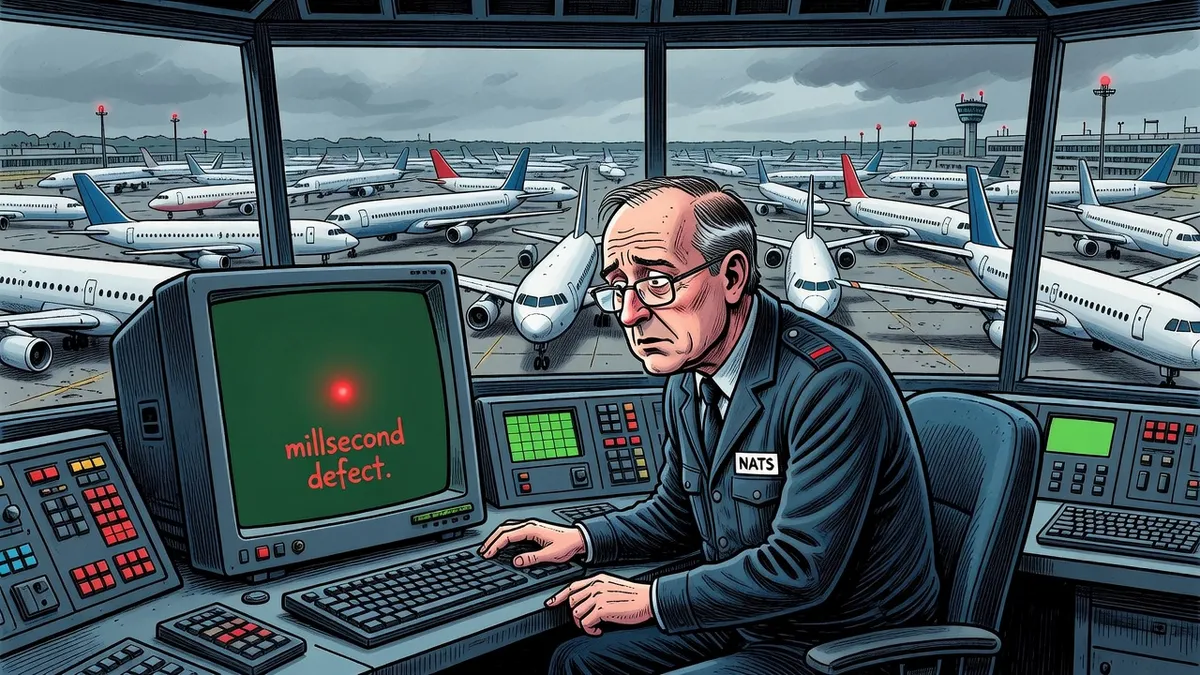
Third air traffic failure since 2023 leaves resilience questions unresolved
Britain’s air traffic control system failed when a single software defect corrupted data during one aircraft code request. The resulting six-hour outage stranded hundreds of thousands of passengers and required more than two days to clear the backlog. National Air Traffic Services recorded the corruption occurring in a millisecond.
The preliminary report identified the flaw in the National Airspace System. A manual code request paused during processing, then resumed with corrupted output that affected subsequent flight data updates. Nats imposed nationwide restrictions to restart the system. No safety breach occurred, yet the operational shutdown spread from London to the rest of the UK and beyond.
This marks the third major air traffic control failure since summer 2023. Airlines responded by calling for the dismissal of chief executive Martin Rolfe. Rolfe stated the latest incident was unrelated to prior events and rejected external speculation about its cause. Mitigation measures are now in place while a permanent fix undergoes safety testing.
Regulatory Response
Transport secretary Heidi Alexander described the disruption as unacceptable. She directed the Civil Aviation Authority to review Nats findings and examine the organisation’s investment plans for future resilience. The CAA review must report within six months. Ministers noted that questions remain over why the defect escaped earlier detection.
Pattern of Underperformance
Critical national infrastructure shows repeated vulnerability to single-point software errors. Each incident produces apologies, temporary restrictions, and promises of fixes without evidence of structural improvement. The pattern spans multiple years and different operational conditions. Passengers absorb the costs through cancelled flights, extended delays, and lost time.
Ordinary travellers face direct consequences when systems designed for reliability cannot maintain service continuity. The six-hour restriction and multi-day recovery demonstrate how narrow technical failures scale into widespread economic and personal disruption. No mechanism has prevented recurrence despite prior warnings.
The episode reveals that accountability for core transport infrastructure remains weak. Officials identify defects after they cause harm, then shift responsibility to regulators for further study. Investment decisions that might prevent the next millisecond-scale failure stay deferred. This cycle continues regardless of which ministers hold office.
Commentary based on Flight chaos for hundreds of thousands was caused in ‘millisecond’ by software error at the Guardian.
← Back to commentary