Scotland’s Grid Cannot Support Its New AI Zone
Power constraints in North Lanarkshire undermine claims of renewable self-sufficiency for Europe’s largest planned AI data centre.
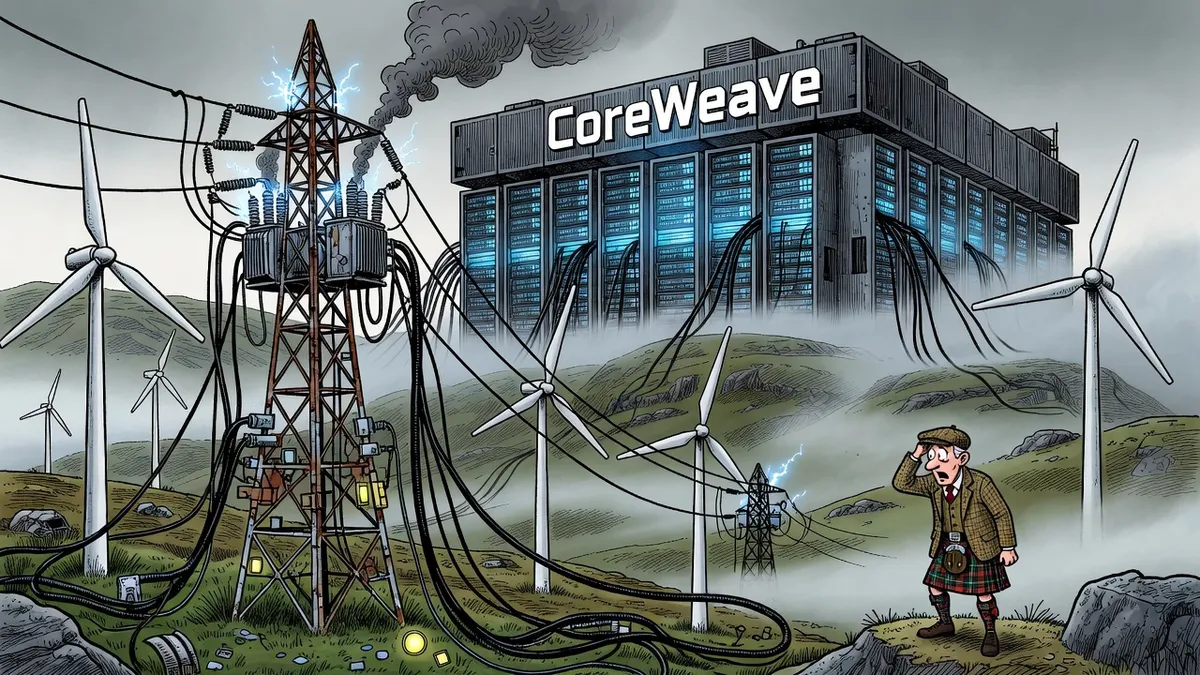
£8.2 billion CoreWeave project encounters connection shortfalls before construction
Scotland’s first designated AI Growth Zone cannot secure the electricity required to operate at planned scale. CoreWeave’s £8.2 billion North Lanarkshire project, announced with private renewable supply exceeding 1 GW, now faces acknowledged shortfalls in grid connection and local distribution capacity.
The gap between stated targets and physical delivery is already visible. Officials have confirmed a power provision issue at the site, even as the company promotes a Power Usage Effectiveness of 1.15 and claims of 97 percent lower carbon intensity than the London grid. These metrics assume the renewable infrastructure materialises on schedule and connects without constraint.
North Lanarkshire holds no surplus grid headroom. Multiple additional data centre proposals across Scotland would together demand more than 1.5 times the country’s current peak national electricity consumption. Existing households, hospitals and manufacturing sites would face direct competition for the same constrained supply.
Energy Allocation Trade-offs
CoreWeave’s plan to pipe waste heat to local hospitals rests on the same premise of excess generation. When generation falls short, the heat recovery system cannot function and the hospitals remain dependent on the strained public grid. The £543 million community fund spread over fifteen years does not expand transmission lines or substations.
The company’s pivot from cryptocurrency mining to AI workloads has not altered the underlying infrastructure requirement. Its £2.5 billion UK commitment, including £1.5 billion pledged in 2025, depends on power costs remaining below 10p per kWh. That price point requires the private renewable array to deliver without curtailment or delay.
Institutional Delivery Record
Scotland’s government designated the zone in January 2026 without resolved grid capacity. Similar patterns appear in other recent large-scale projects where planning approvals precede confirmed energy availability. The result is capital committed on paper while operational delivery slips.
Local sentiment has already moved from anticipated employment gains to concern over bill impacts. When data centre load materialises ahead of new generation or transmission, residential and industrial users absorb the constraint through higher costs or rationing.
This episode records another instance of promised private infrastructure outrunning the public network’s ability to accommodate it. Britain continues to approve headline investments whose core operating requirement, reliable power at scale, remains unaddressed in practice.
Commentary based on CoreWeave’s £8.2B AI datacentre in Scotland faces power supply concerns by Editorial Team on Crypto Briefing.
← Back to commentary