Staff cuts surge to pandemic-era speeds
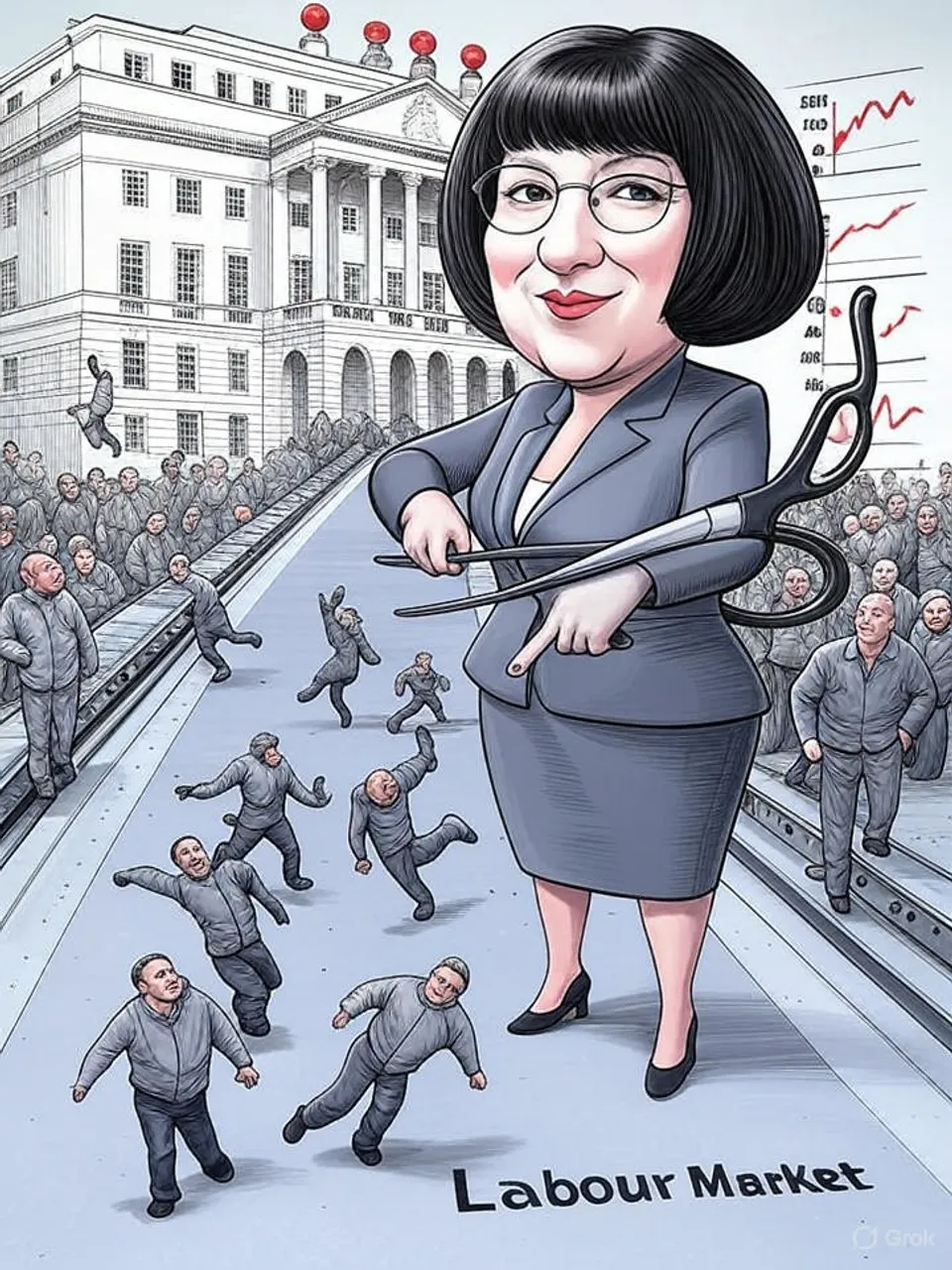
Private employment falls 1.8% in November as Budget fog triggers fastest purge since 2021
Bank of England data records the sharpest private-sector job drop since mid-2021, with unemployment at 5%. Policy chaos across governments erodes business confidence and labour market stability.
Commentary Based On
GB News
Bank of England issues urgent economy warning as employers cut staff at fastest pace since pandemic
Private-sector employment collapsed 1.8 per cent in November, according to Bank of England survey data. This marks the sharpest monthly contraction since July 2021, when pandemic restrictions were still unwinding. Firms now anticipate cutting a further 0.7 per cent of staff over the coming year—the bleakest outlook since October 2020.
Official unemployment figures tell the same story. The rate hit five per cent in the three months to September, exceeding analyst forecasts of 4.9 per cent and reaching levels not seen since late 2020. ONS director Liz McKeown described the labour market as “weakening.” Vacancies held steady, but pay growth slowed to 4.6 per cent from 4.7 per cent—a deceleration that signals cooling demand rather than economic strength.
The timing reveals the cause. Pre-Budget government signals triggered the chaos. Ministers issued contradictory briefings on tax hikes throughout the autumn. Firms delayed hiring and planning amid the fog. Pantheon Macroeconomics chief economist Rob Wood linked the employment collapse directly to this speculation. When the October Budget finally arrived, it confirmed what businesses had feared: tax increases and spending shifts that would hit confidence and margins.
The Bank of England now signals a likely quarter-point rate cut in December. Employment data has overridden inflation concerns for now, despite CPI lingering at 3.6 per cent—well above the two per cent target. Three-year inflation expectations climbed to three per cent in the survey. One-year projections stuck at 3.4 per cent. Governor Andrew Bailey must soon explain how the Bank plans to navigate this bind: support a hemorrhaging labour market or fight persistent inflation.
The Pattern Repeats Across Governments
Budget uncertainty is not new, nor is it unique to this administration. Business surveys have repeatedly cited fiscal opacity as an economic drag over multiple years. Pre-2024 election periods saw similar wobbles under the previous government. Each administration promises stability and delivers volatility. Each Chancellor unsettles markets with ambiguous signals and last-minute policy shifts.
The consequences compound. Firms respond by shedding staff first and investment second. Productivity stagnates as businesses adopt defensive postures. ONS data shows payroll growth faltering since mid-2023—before this Budget, before this government took office. Previous fiscal events yielded identical survey responses. The institutional pathology persists regardless of the party in power.
This November’s purge did not emerge from a vacuum. It represents the culmination of entrenched dysfunction across the machinery of government. Ministers from both major parties have unsettled business confidence through contradictory messaging, policy reversals, and fiscal surprises. No minister faces direct penalty for these failures. Institutions absorb the shocks without reform. Ordinary workers pay through lost wages, reduced hours, and diminished opportunities.
Labour Market Data Reveals Deeper Strain
The five per cent unemployment figure understates the problem. Economic inactivity persists above pre-pandemic norms. Disability benefit rolls continue swelling, per ONS trends documented over the past eighteen months. Underemployment remains elevated among those still in work. Vacancy stability offers no comfort—it signals skills mismatches and employer reluctance to commit, not genuine labour market health.
Pay growth deceleration points to weakening demand across the economy. Real wage gains remain marginal when measured against inflation. Households continue drawing down savings accumulated during pandemic support programs. Consumer spending growth has slowed accordingly. The labour market contraction feeds directly into reduced household income, which will further suppress demand in coming quarters.
Public debt servicing now consumes record budget shares, constraining fiscal room for intervention. The private sector bears the adjustment load. Future hiring prospects dim as firms anticipate continued policy uncertainty regardless of which party governs. Business investment has stagnated for years—a problem that predates current political leadership and appears impervious to it.
Institutional Failure Compounds
This employment collapse reveals how UK economic institutions function in practice. Successive governments prioritise short-term political management over sustained growth. Budget processes remain opaque until the last moment, creating preventable uncertainty. Ministers leak contradictory signals that unsettle markets. Treasury orthodoxy persists across administrations, yielding similar patterns of dysfunction.
The Bank of England faces impossible choices created by this institutional environment. Monetary policy cannot compensate for fiscal chaos. Rate adjustments may ease borrowing costs but cannot reverse structural weaknesses in business confidence, skills provision, or infrastructure investment. The central bank’s independence proves limited when government policy creates economic volatility that forces reactive monetary responses.
Cross-departmental coordination remains absent. Economic policy lacks coherent strategy beyond quarterly political cycles. Long-term planning receives rhetorical commitment but no institutional backing. Business groups have raised these concerns repeatedly over successive parliaments. Nothing changes. The machinery grinds forward, generating predictable failures that nobody in authority appears able or willing to prevent.
The Decline Compounds, Unaddressed
November’s data captures a moment in Britain’s ongoing economic deterioration. Labour markets contract under repeated policy blows from governments of both parties. Officials claim control while data shows erosion. The gap between stated competence and measurable outcomes widens.
Firms respond to institutional dysfunction by exiting sectors, relocating operations, or automating roles. Those options remain available only to larger enterprises. Smaller businesses simply fail or stagnate. Workers caught in this vice face stagnant wages, reduced hours, or unemployment. The social costs accumulate as economic opportunity narrows.
The pattern will repeat. Future Budgets will generate similar uncertainty. Employment will contract again. Analysts will express surprise. Ministers will promise better next time. The institutional pathology that produces these outcomes faces no serious challenge. Reform receives discussion but not implementation. The decline continues, documented in monthly data releases that few read and fewer act upon.
Britain’s labour market is not experiencing a temporary adjustment or a cyclical downturn. It is exhibiting the symptoms of systemic institutional failure that transcends individual governments and resists conventional policy responses. The November employment collapse makes this visible to anyone willing to examine the evidence. Whether anyone in authority will prove willing remains the unanswered question.
Commentary based on Bank of England issues urgent economy warning as employers cut staff at fastest pace since pandemic at GB News.