State Contracts Route £24 Billion to Debt-Laden Owners
Analysis of procurement data shows high-leverage firms now deliver transport, care and NHS services under structures that prioritise investor returns over operational resilience.
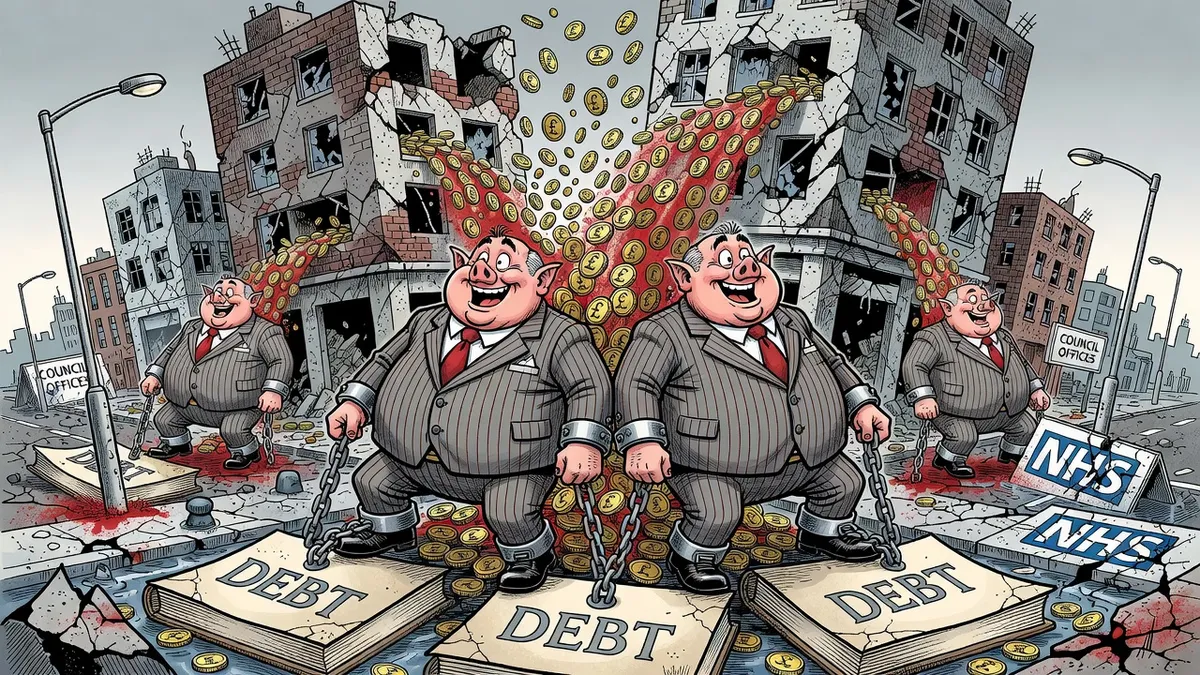
Private equity controls 8.8 percent of public spending on external providers
Almost £24.4 billion in public contracts last year reached companies controlled by private equity firms. This represented 8.8 percent of total government spending on external providers.
Local councils directed £9.8 billion to such firms. The NHS allocated more than £5 billion. The Department for Education spent £600 million. Each figure equals roughly one tenth of their respective external budgets.
Private equity structures typically load acquired companies with debt to fund acquisitions and returns. This creates fixed obligations that persist regardless of service demand or revenue stability. When those companies deliver water, transport, childcare or adult care, the state retains ultimate responsibility for continuity.
Debt and Extraction Patterns
Thames Water’s difficulties followed years of dividend payments and leverage under private equity ownership. Similar models now operate in bus and rail routes through Arriva, in pharmacy chains, and in children’s residential care. Failures in any of these sectors trigger direct public intervention because users cannot simply exit.
Procurement records show repeated contract awards to the same ownership groups. Officials record value for money at the point of tender yet lack mechanisms to track subsequent capital extraction or service degradation. The result is a growing share of essential delivery sitting inside entities whose primary duty runs to investors rather than users.
Cross-Party Continuity
Outsourcing expanded under successive governments of both main parties. Austerity reduced in-house capacity while procurement rules favoured lowest price over ownership structure. No administration reversed the trend once private equity presence became visible in care homes, hospitals and local services.
The same data set reveals consistent outcomes. High-leverage operators cut staffing costs to service debt. Regulators then face the choice between allowing service collapse or injecting public funds to stabilise the provider. That choice repeats across sectors without alteration of the underlying model.
Britain now routes core functions through ownership forms that concentrate financial risk and disperse operational accountability. The £24.4 billion figure records not an experiment but a settled operating system whose reversibility shrinks with each contract cycle.
Commentary based on ‘Financial pandemic’: £1 in every £11 spent on UK public contractors goes to private equity at the Guardian.
← Back to commentary