Wildfires Breach Fixed UK Response Limits
Prolonged heat since May produced evacuations in Wales and the Peak District plus highest Fire Severity Index levels in southern England without structural service reserves.
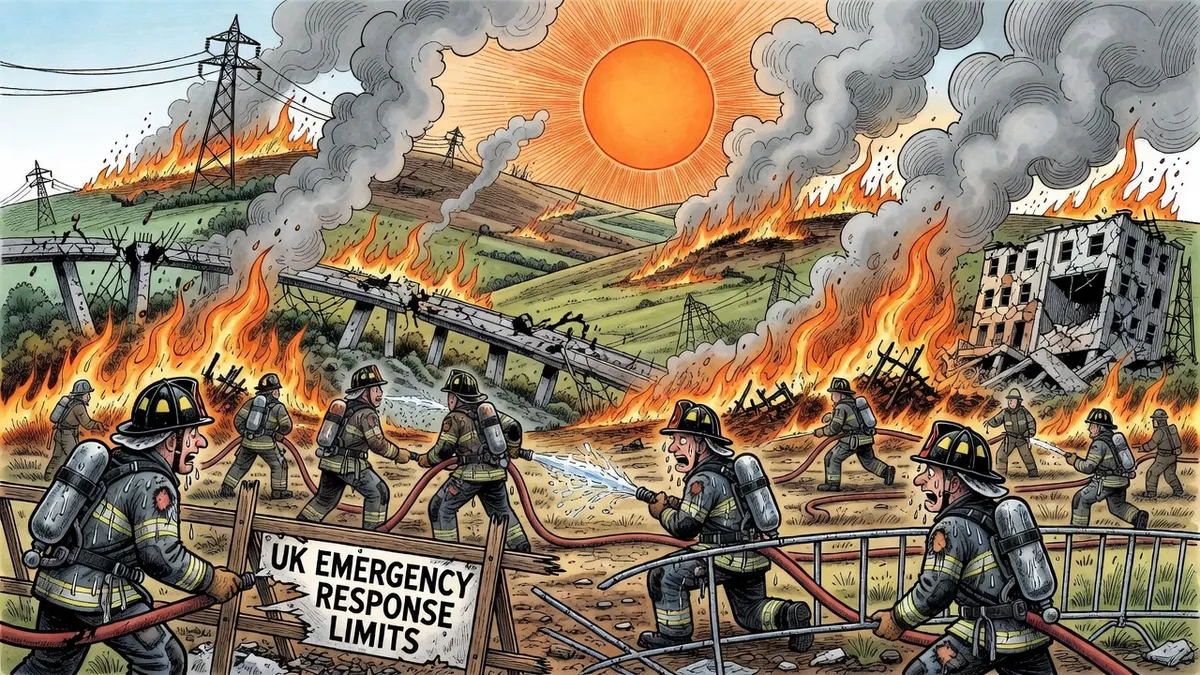
Exceptional risk ratings and multiple major incidents expose unchanged emergency capacity during repeated heatwaves
Multiple wildfires forced evacuations across Wales and the Peak District while southern England received the highest wildfire risk classification on record. Natural England placed areas including the Isle of Wight, Bognor Regis and Lyme Regis under “exceptional” conditions on its Fire Severity Index. Officials cited weeks of dry vegetation and repeated heatwaves since May as the trigger.
The Conwy Mountain fire in north Wales triggered a major incident declaration. Residents left homes as crews battled flames spread by strong winds. North Wales Fire and Rescue Service footage showed extensive blackened hillside and thick smoke visible from nearby properties.
Capacity Shortfalls
Tintwistle Moor in the Peak District also reached major incident status. Overnight winds reignited flames after initial containment attempts. Helicopters and specialist teams deployed, yet the blaze continued into Monday.
London Fire Brigade had already issued an “extreme” risk warning over the weekend. A trackside fire closed part of the Overground network. Another blaze on the capital’s southeastern edge disrupted transport without warning.
The National Fire Chiefs Council noted that the third heatwave of the season was projected to exceed prior durations. Even small ignition sources now carry elevated potential for rapid spread across heathland and moor. This marks a measurable shift from historical fire patterns in the same regions.
Recurring Institutional Pattern
Emergency planning has treated prolonged heat as an occasional event rather than a recurring operational stress. Infrastructure across ambulance trusts, rail networks and countryside access controls shows fixed capacity without structural reserves. Similar shortfalls appeared during earlier summer heat episodes this year.
Public advisories focus on individual behaviour such as avoiding barbecues and discarding cigarettes. These measures do not address underlying gaps in land management, vegetation control or rapid-response scaling. The same heat-driven conditions have now produced multiple simultaneous major incidents without evidence of improved containment timelines.
Britain’s systems record repeated exposure to elevated temperatures without corresponding upgrades in preparedness thresholds. Each episode produces evacuations, transport closures and highest-level alerts while core response capacity remains unchanged from previous years.
Commentary based on UK Wildfire: Wales wildfire triggers evacuations as Manchester blaze rages; Southern England placed under ‘exceptional’ wildfire risk amid scorching heat by Trending Desk on The Economic Times.
← Back to commentary