Oil Prices Lock UK Borrowing Costs in Place
External oil shocks continue to dictate UK monetary policy while structural energy dependence remains unaddressed.
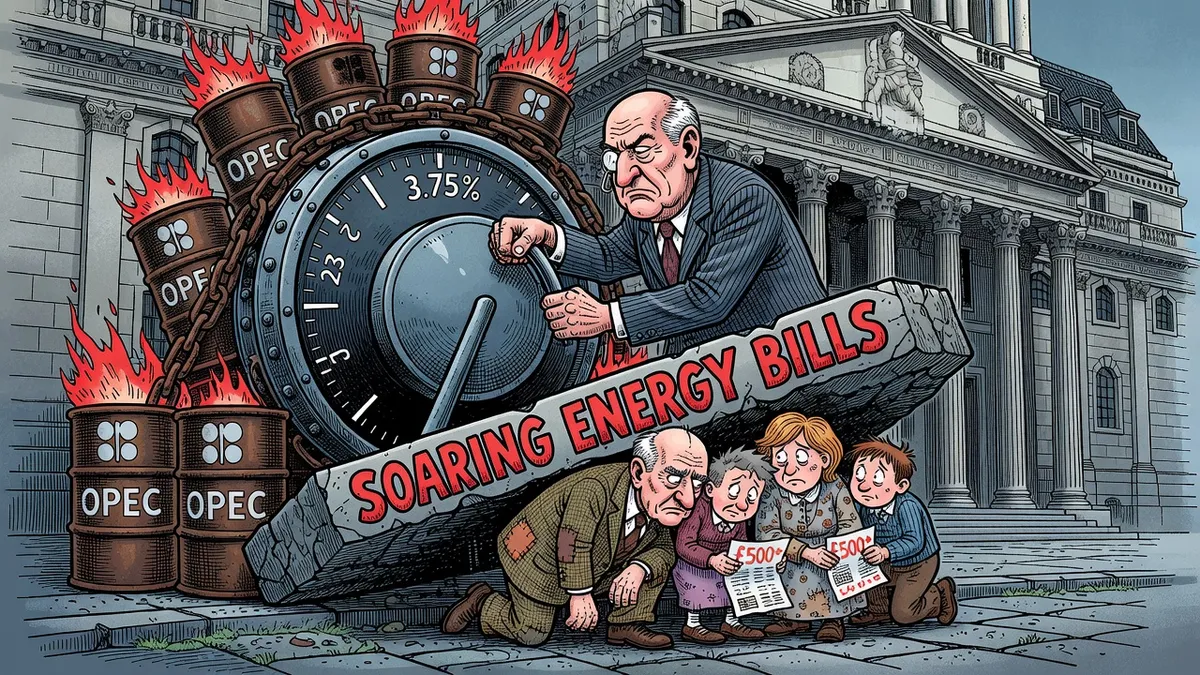
Bank holds rates at 3.75% as imported energy risks override domestic inflation drop to 2.6%
Britain’s central bank kept its base rate fixed at 3.75 percent even as June inflation fell to 2.6 percent. The decision rested on fears that renewed conflict around Iran could push oil above 100 dollars a barrel and drive inflation to 4.5 percent by mid-2027.
The Monetary Policy Committee split six to three. Three members voted to raise rates immediately, citing risks that temporary energy costs could feed into wages and prices. The majority chose to wait, citing weak domestic growth and the absence of entrenched inflationary pressure.
Official forecasts assume oil will fall back to 71 dollars a barrel. Under that scenario inflation peaks near 3.2 percent later this year before easing. Any sustained elevation in energy costs would erase that path and force households to absorb higher bills without corresponding wage gains.
Prime Minister Andy Burnham’s announced measures remove VAT from electricity bills and cap bus fares at two pounds. The Bank estimates these steps will trim headline inflation by 0.1 percentage points. Such adjustments alter measured prices without changing the underlying exposure to imported fuel.
The UK has now absorbed successive external shocks from pandemic supply chains, the 2022 Ukraine invasion, and current Middle East fighting. Each episode produced higher energy costs and delayed rate relief, yet none prompted structural reduction in import dependence.
Domestic output remains too weak to support either sustained rate cuts or pre-emptive hikes. Markets still assign over 90 percent probability to unchanged policy through the summer, with investors expecting any rise to reach only 4 percent by year end.
Persistent Exposure
This latest pause repeats a familiar sequence. Global commodity movements set the terms for UK monetary settings. Domestic policy then applies small fiscal offsets that register in official statistics but leave household energy costs tied to events abroad.
The central bank’s own language underscores the constraint. An “adverse scenario” of prolonged war and oil above 100 dollars lies outside its control yet inside its inflation projections. No parallel scenario exists for rapid domestic production increases or diversified supply that would blunt the impact.
Structural Outcome
Britain therefore faces renewed cost-of-living pressure without the policy tools that once insulated similar economies. Rate decisions now function mainly as responses to imported price spikes rather than levers for domestic expansion. The gap between falling measured inflation and the risk of renewed spikes measures the distance between stated stability goals and actual resilience.
Commentary based on Bank of England holds interest rates at 3.75% as inflation fears mount by Richard Partington on the Guardian.
← Back to commentary